Summary
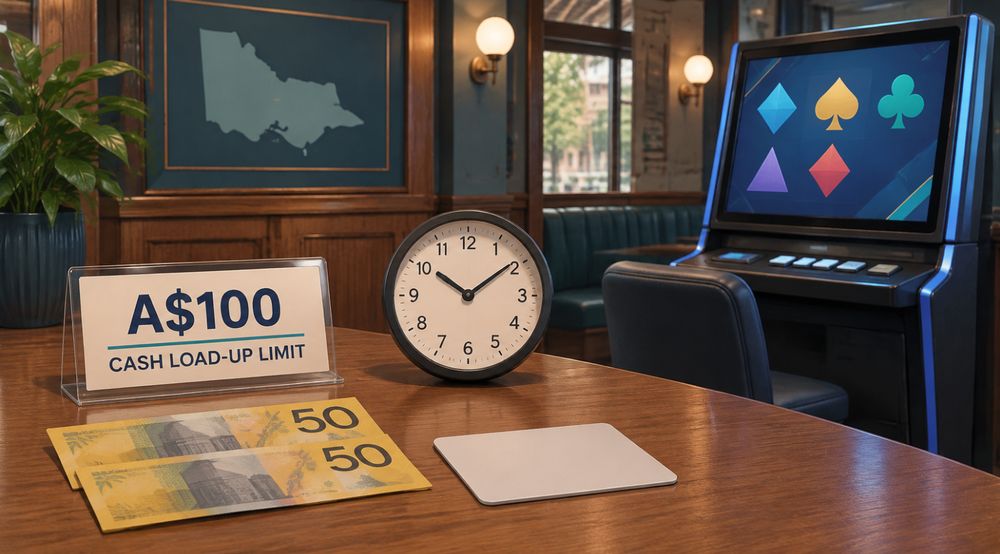
Victoria’s A$100 pub and club pokie cash load-up limit is not a A$100 daily spending or loss cap. It restricts cash entering a machine – not your total gambling expenditure.
- Cash loading: A machine cannot accept cash that takes its credit balance above A$100. Banknotes above A$50 are prohibited.
- Tickets and winnings differ: TITO tickets are treated separately, and winnings can increase a machine’s balance above A$100.
- Venue cash access has separate limits: At non-racecourse gaming venues, cash withdrawals are restricted to A$200 per card transaction and A$500 per card within 24 hours.
- YourPlay is not compulsory everywhere: The regulator guidance reviewed for the article still describes participation as voluntary outside Crown Melbourne. Passing legislation does not establish that statewide mandatory carded play has commenced.
- Crown Melbourne has different requirements: Electronic gaming machine players must register for YourPlay and set time and loss limits.
- Other operating rules matter: Hotel and club games must have a minimum three-second spin rate, and machines cannot be played between 4 am and 10 am.
The practical takeaway: check the rules applying to your venue, distinguish operating requirements from announced reforms, and never treat a regulatory cash threshold as an affordable gambling budget.
Victoria’s Pokie Rules in 2026: Cash Limits, YourPlay and What Has Actually Changed
Victorian pub and club pokies now have a A$100 cash load-up limit. However, that is not a A$100 daily gambling limit, and it does not mean mandatory carded play has already started at every venue.
That distinction matters before your next visit.
Victoria’s reforms involve several separate measures: restrictions on loading banknotes, access-to-cash rules, slower games, overnight gaming closures and the development of broader mandatory pre-commitment.
Some measures are operating. Others have passed through Parliament but require further implementation steps. Crown Melbourne also has requirements that differ from ordinary hotels and clubs.
This review separates those categories and explains what the rules mean in practice.
The status below reflects Victorian Gambling and Casino Control Commission guidance available on 16 November 2026. It should not be read as a claim that every reform announced since 2023 commenced simultaneously.
What Has Actually Changed?
For someone visiting a Victorian hotel or club gaming room, the main practical points are:
-
Machines cannot accept cash that takes the credit balance above A$100.
-
The cash load-up rule does not apply in the same way to Ticket-In-Ticket-Out tickets.
-
Banknotes above A$50 must not be accepted.
-
Games must not operate with a spin rate below three seconds.
-
Hotel and club gaming machines cannot be played between 4 am and 10 am.
-
YourPlay must be available, but current regulator guidance still describes participation as voluntary outside Crown Melbourne.
-
Crown Melbourne already requires registered YourPlay participation for electronic gaming machine play.
There are also separate restrictions on obtaining cash from venue facilities.
The result is not one universal “cash limit”. It is a collection of controls operating at different points in a venue visit.
The 2026 Reform Status at a Glance
| Measure | Position in published regulator guidance | Practical meaning |
|---|---|---|
| A$100 cash load-up limit | Operating in Victorian hotels and clubs | Cash cannot be loaded if it takes machine credits above A$100 |
| Maximum banknote denomination | Notes above A$50 prohibited | A$100 load-up capacity does not mean A$100 notes are accepted |
| Minimum game speed | At least three seconds | Games must not operate faster than this threshold |
| Overnight closure | 4 am to 10 am for hotel and club gaming | A venue being open does not mean its machines may operate |
| YourPlay availability | Mandatory on machines | Venues must provide the system |
| YourPlay participation outside Crown | Still described as voluntary | Availability and compulsory player use are different requirements |
| Crown Melbourne EGM pre-commitment | Mandatory | Registered players must set time and loss limits |
| Broader mandatory carded-play rollout | Legislative framework passed; implementation timing requires confirmation | Do not assume universal commencement from passage of the legislation |
This is the central watchdog test: distinguish an announcement, an enacted framework and an operating requirement.
They are not interchangeable.
How the A$100 Cash Load-Up Limit Works
The rule concerns cash entering a machine and the credit balance at that point.
The regulator states that hotel and club machines cannot accept more than A$100 in cash at any one time or accept additional notes that take the balance above A$100.
Consider three examples.
An empty machine
Starting from zero credits, a machine may accept eligible banknotes up to the A$100 threshold.
It must still comply with the separate prohibition on accepting banknotes above A$50.
A machine with A$80 remaining
An additional A$50 note would take the balance to A$130.
The machine should not accept that cash load.
A balance increased by winnings
The rule does not mean a winning result must stop at A$100.
It is a cash-loading restriction, not a cap on the amount a machine can display after a win.
The regulator also identifies a group of older machines operating under a different communications protocol with a lower limit. Players should therefore not assume every machine will accept precisely the same load.
What the A$100 Rule Does Not Mean
The most important correction is that A$100 is not a daily loss ceiling.
The rule does not, by itself:
-
Restrict total daily gambling expenditure to A$100.
-
Limit turnover to A$100.
-
Guarantee that a player loses no more than A$100.
-
Establish a personal budget across multiple visits.
-
Make all payment methods subject to an identical A$100 threshold.
A person’s cumulative expenditure can exceed the amount held on a machine at one moment.
That is why the load-up reform should not be described as a complete spending-control system.
Its immediate function is narrower: it reduces the amount of cash that can be loaded into a machine while the balance remains at or below the threshold.
Personal loss limits and mandatory pre-commitment address different aspects of gambling.
TITO Tickets: The Important Qualification
Ticket-In-Ticket-Out, usually shortened to TITO, allows machine credits to be represented by a printed ticket.
The regulator expressly states that the A$100 cash load-up limit does not affect the operation of TITO tickets. Machines can accept tickets carrying A$100 or more.
This means a machine balance above A$100 does not automatically establish a breach.
The balance might reflect winnings or a qualifying ticket transaction rather than an excessive cash load.
For players, the key distinction is between:
-
Cash inserted.
-
Ticket value transferred.
-
Credits won.
-
Total money spent over time.
For anyone assessing the reform’s effectiveness, the treatment of different funding methods is an important limitation to examine.
It should not be presented as an invitation to work around spending safeguards.
A ticket represents money at risk, not free credits.
Venue Cash Withdrawal Limits Are Separate
The rules governing access to cash operate independently of the machine load-up limit.
For approved venues that are not on a racecourse, current regulator guidance permits only approved ATMs or compliant EFTPOS facilities.
Those facilities must not allow:
-
More than A$200 per card transaction.
-
More than A$500 on any one card within 24 hours.
-
Cash advances from a credit account.
The regulator says the 24-hour period starts with the first withdrawal.
These figures are restrictions on venue cash facilities. They are not government-approved gambling budgets.
A person who can access A$500 has not been assessed as able to afford losing it.
Staff-operated EFTPOS
Cash withdrawals through EFTPOS must be handled by a venue employee, including entering the withdrawal amount.
The regulator links this requirement to monitoring withdrawal frequency and responding to signs of gambling harm or distress.
Staff involvement is therefore not necessarily an administrative inconvenience. It is part of the venue’s compliance responsibilities.
Racecourse venues require extra care
Racecourse venue rules depend partly on the location of the cash facility relative to the gaming machine area.
Do not assume the non-racecourse arrangements apply identically throughout every racecourse property.
Is Mandatory Carded Play Operating Everywhere?
No universal commencement should be inferred from the material reviewed.
The Gambling Legislation Amendment (Pre-commitment and Carded Play) Bill 2024 passed Parliament on 27 May 2025.
However, the regulator also announced that the planned May–June 2025 trial had been postponed.
Its notice said implementation timeframes would be updated and further directions, regulations and consultation would follow.
More recent 2026 regulator pages continue to describe YourPlay participation as voluntary for players outside Crown Melbourne.
That is materially different from saying every Victorian pub and club player must already register and use a mandatory card.
The accurate position is that the wider framework has advanced, but a claim of statewide compulsory operation needs a confirmed commencement instrument or current official implementation notice.
A news headline about legislation passing is not enough.
What Does “Dynamic Carded Play” Mean?
“Dynamic carded play” should not be treated as the name of a separate statewide requirement merely because the phrase appears in commentary.
The official material reviewed uses terms including mandatory carded play, pre-commitment, YourPlay and technology-neutral implementation options.
These describe related but distinct functions.
Carded play
Carded play links gambling activity to a player account or recognised card-based identity arrangement.
The exact registration and verification requirements depend on the applicable system.
Pre-commitment
Pre-commitment means deciding limits before gambling.
Those limits can concern time, expenditure or losses, depending on the framework.
Cashless payment
Cashless payment concerns how money is transferred.
A cashless payment method does not automatically establish that meaningful personal loss limits are mandatory or enforced.
Mandatory enforcement
A genuinely enforced limit stops further play when the applicable threshold is reached.
A warning that can be disregarded is not equivalent to an enforced stop.
Any venue explanation should identify which of these functions actually applies.
What YourPlay Currently Does
YourPlay is Victoria’s statewide pre-commitment system.
It allows players to set time and money limits and track recorded machine play across participating Victorian gaming infrastructure.
Venues must make the system available on their machines.
However, mandatory availability does not mean every person outside Crown must use it.
That difference explains why two statements can both be correct:
-
A hotel must provide YourPlay.
-
A hotel patron’s participation may remain voluntary under the current arrangements.
Before using it, ask staff to explain registration, activity tracking, limit notifications and how the applicable limits operate.
Do not assume every function is identical to the mandatory casino arrangement.
A monitoring system is most useful when the player understands what is recorded and what happens when a limit is reached.
Crown Melbourne Has a Different Starting Point
Crown Melbourne already requires people playing electronic gaming machines to register for and use YourPlay.
Players must set time and loss limits before starting.
The regulator states that casino players cannot continue beyond their pre-set limits.
This is not simply an optional loyalty feature.
Crown’s requirements arose through casino-specific regulatory directions, including harm-minimisation and anti-money-laundering measures.
For that reason, a visitor should not transfer assumptions between Crown and a suburban hotel.
Equally, the hotel-and-club A$100 cash-loading guidance should not automatically be presented as a complete statement of Crown’s funding arrangements.
Check the requirements for the specific venue category.
The relevant distinction is regulatory scope, not whether the machines look similar.
Three-Second Games: Slower Does Not Mean Safe
Current regulator guidance says venue operators must not allow games with a spin rate below three seconds.
The reform reduces the permitted pace compared with the earlier 2.1-second threshold identified in the government’s original package.
However, slower play does not change a losing game into a profitable one.
It also does not guarantee a lower final loss for every player. Someone could stay longer, increase spending or otherwise change behaviour.
The useful interpretation is limited: the rule constrains game speed.
It does not replace an affordable budget, a time limit or a decision to stop.
A venue should not market the reform as proof that machine gambling is now financially safe.
The 4 am to 10 am Shutdown Still Matters
Hotel and club gaming machines cannot be played during the mandatory daily closure period from 4 am to 10 am.
The closure commenced on 30 August 2024 and remains reflected in current regulator guidance.
A pub may have separate permission to serve food, show sport or conduct other activities.
That does not automatically authorise gaming machines to operate during the prohibited period.
Venue-specific licence conditions and public-holiday restrictions can also require shorter gaming hours.
The practical question is not simply whether the building is open.
Ask whether the gaming room is permitted to operate at that time.
A standard closure period is a regulatory boundary, not an invitation to resume gambling as soon as the clock reaches 10 am.
What Happens When You Collect Winnings?
Machine funding limits and payout rules are separate.
A A$100 cash load-up restriction does not mean a legitimate balance above A$100 cannot be collected.
However, larger balances may require a non-cash payment process.
The regulator’s cash-facilities guidance states that cash payment of accumulated machine credits totalling A$2,000 or more is prohibited.
It also describes cheque and electronic funds transfer arrangements, including a 24-hour delay before relevant EFT funds become available.
Because parts of the same guidance use slightly different wording around the exact A$2,000 boundary, ask the venue to confirm its application of the statutory rule if your balance is exactly that amount.
Do not assume an immediate cash payout.
Keep any ticket, voucher or written payment confirmation until the transaction is complete.
What to Ask Before Your Next Visit
A short conversation with staff can resolve most practical uncertainty.
Ask:
-
Is YourPlay optional or mandatory at this venue?
-
What does registration require?
-
How do time and loss limits operate here?
-
What cash-loading limit applies to this machine?
-
What are the venue’s cash-access restrictions?
-
What happens when I collect a larger balance?
-
Where can I find the current written rules?
Staff should distinguish venue policy from legislation and regulator requirements.
An answer such as “the government changed everything” is not sufficiently precise.
A clear explanation identifies the measure, the venue category and whether the requirement is currently operating.
What a Trustworthy Reform Update Should Tell You
A useful industry update needs more than a new year in its headline.
It should distinguish:
-
Announcement dates from commencement dates.
-
Legislative powers from operational systems.
-
Cash load-up limits from daily loss limits.
-
Hotel and club rules from casino rules.
-
Voluntary tools from enforced restrictions.
-
Payment technology from harm-minimisation outcomes.
The 2026 monitoring-licence announcement provides another example.
The regulator says the next monitoring and pre-commitment licence begins on 16 August 2027, with existing arrangements continuing until then.
That future licence start is not, by itself, proof of a universal mandatory carded-play commencement date.
Infrastructure procurement and player obligations require separate verification.
If a Machine or Venue Appears Non-Compliant
Do not keep gambling to test whether something is wrong.
Stop and ask a supervisor to explain the issue.
Where appropriate, note:
-
The venue and machine identifier.
-
The date and approximate time.
-
The amount involved.
-
Any displayed message.
-
The explanation provided by staff.
Keep relevant receipts and tickets.
Use the venue’s dispute process and contact the VGCCC if the issue remains unresolved or concerns suspected non-compliance.
A report should describe what happened rather than assume a breach from a balance alone. A machine displaying more than A$100 may not have breached the cash-loading rule.
For financial distress or difficulty stopping, support is more important than resolving a technical argument.
Frequently Asked Questions
Can I lose more than A$100?
Yes. The hotel-and-club rule limits cash loading relative to the machine balance. It is not a daily personal loss cap.
Can a machine accept a A$100 note?
No. Current hotel-and-club compliance guidance prohibits acceptance of banknotes above A$50.
Must I register for YourPlay at every Victorian pub?
Current regulator guidance reviewed for this article does not establish universal compulsory participation at pubs and clubs. Crown Melbourne’s EGM requirements are different.
Does carded play mean gambling is cashless?
Not necessarily. Identifying a player, recording activity, enforcing limits and transferring money are separate functions.
Does a venue cash limit tell me what I can afford?
No. Regulatory limits are not personalised financial advice or spending recommendations.
Final Verdict
Victoria’s A$100 hotel-and-club cash load-up limit is operating, but it is narrower than a A$100 gambling cap.
The most important practical changes sit alongside it: restricted access to cash, slower games, overnight closures and a wider pre-commitment reform programme whose operational status must be checked carefully.
For your next visit, distinguish what the machine accepts, what the venue allows and what your personal limit should be.
No regulatory threshold makes gambling affordable by default.
For free, confidential gambling support, call 1800 858 858.
Sources
- VGCCC: Current hotel and club machine compliance, A$100 cash load-up limit, TITO treatment, banknote restrictions and minimum spin rate
- VGCCC: Cash-access limits, staff-operated EFTPOS, racecourse distinctions and payout requirements
- VGCCC: Passage of pre-commitment legislation and postponement of the planned carded-play trial
- VGCCC: YourPlay availability and voluntary pre-commitment arrangements
- VGCCC: Player guidance on YourPlay and mandatory casino time and loss limits
- VGCCC: Crown Melbourne’s mandatory electronic gaming machine pre-commitment requirements
- VGCCC: Current hotel and club gaming hours and public-holiday qualifications
- VGCCC: Commencement and operation of the mandatory 4 am to 10 am closure period
- VGCCC: Monitoring and pre-commitment licence arrangements and the August 2027 transition