Summary
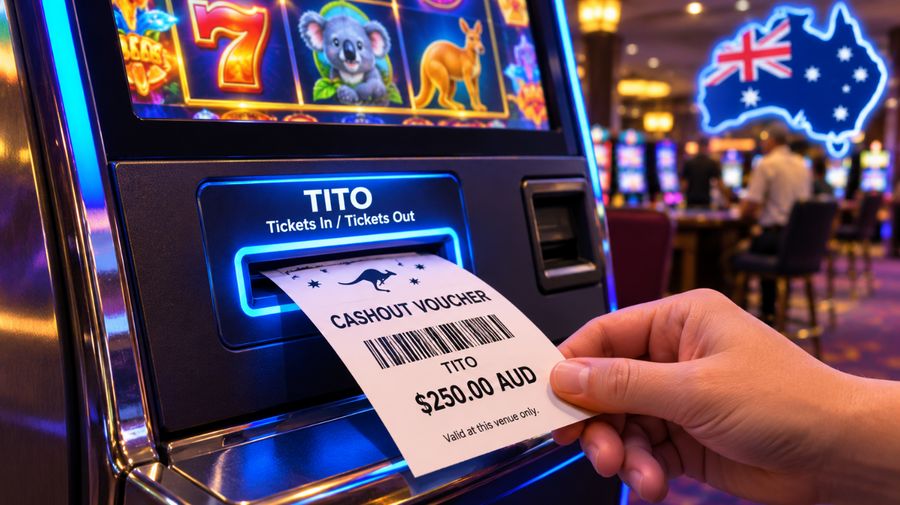
Ticket-In, Ticket-Out (TITO) replaces coins with a barcoded ticket for your remaining credit. You can redeem it for cash, or insert it into another eligible machine.
- How a ticket is made: Pressing Collect sends a request to the venue’s central system. The machine prints only after the system approves it.
- Three options: Redeem at a cashier or cage, use a self-service cash redemption terminal, or insert the ticket into another TITO-enabled machine.
- Check the value first: Look at the amount on the ticket before you leave the machine. If it looks wrong, tell staff straight away.
- Expiry matters: In NSW and SA, tickets expire 12 months after issue and expired tickets cannot be redeemed. In SA, a ticket can be used in another machine for up to 30 days.
- Large wins may be paid differently: Big amounts can be paid by cheque or EFT, or as a hand pay by staff, instead of a printed ticket.
- Lost or damaged tickets: Keep all the pieces and tell staff. Venues should have a process where your identity and claim can be established.
- Don’t trade tickets: AUSTRAC warns that criminals offer cash for winning tickets, so redeem only your own.
- Rules vary: TITO is not compulsory in every state. Limits and procedures differ by state and venue, so ask staff if you’re unsure.
- Online sites are different: TITO is a venue feature. Real-money online casino games cannot lawfully be supplied to people in Australia.
If gambling is causing harm to you or someone close to you, call 1800 858 858 for free, confidential support.
How TITO Pokie Tickets Work in Australia: Redeeming, Expiry, Limits and Lost Tickets
When you press Collect on a TITO-enabled pokie, the machine prints a barcoded ticket worth your remaining credit. You can redeem it for cash at a cashier or self-service terminal, or insert it into another eligible machine to keep playing.
TITO is not compulsory, and the rules differ by state. Victoria’s regulator, for example, says introducing cashless gaming in venues is not compulsory. A venue may offer cash payouts, tickets, or a mix, and the limits and expiry details depend on the state and the venue’s setup. This guide covers the general mechanics, with state examples where they matter. The notice on the machine and the venue’s staff are the final word for your venue.
What TITO Means
Ticket-In, Ticket-Out is a payout system that replaces coins and hand-paid vouchers with a barcoded ticket. Victoria’s regulator describes it as technology that lets patrons collect credits from a poker machine on a barcoded ticket, then exchange it for cash or use it in another machine.
South Australia’s regulator uses a simple comparison:
-
Ticket-in works like putting cash into a machine.
-
Ticket-out works like pressing Collect and receiving your credits in a different form.
A ticket is a record of money you’re owed by the venue’s system. It is not cash in itself, and it isn’t a casino chip or a loyalty voucher. The barcode links to a record held by a central system, which is why a ticket can be checked as valid before it’s paid.
What Happens When You Press Collect
The sequence is a little more controlled than it looks.
-
You press Collect on the machine.
-
The machine asks the central TITO system for authorisation.
-
The system approves or rejects the request.
-
Only after approval does the machine print the ticket.
South Australia’s guidelines describe it that way: the machine waits in a pending state until the host authorises or rejects the request, and prints only after approval. They also say the ticket carries a unique identifier, its value and a condensed warning message.
If the machine hesitates for a moment before printing, it is probably waiting for that approval. Don’t press Collect again or walk away. Wait for the ticket, or call staff if it doesn’t come out.
What’s on a Ticket
A typical ticket shows:
-
the dollar value
-
the date and time it was issued
-
the machine it came from
-
a barcode and validation number
-
a short responsible gambling message
Check the value before you leave the machine. If the amount looks wrong, tell staff straight away, before you’ve inserted or redeemed the ticket. Machine meters, game history and the central system’s records can usually be checked, but it’s easier while you’re still at the machine.
Your Three Options
Once you have a ticket, you generally have three choices.
1. Redeem it at a cashier or cage
Staff scan the ticket, the system validates it, and you’re paid. Victoria’s guidelines say staff should validate tickets on the system before payment, except during system downtime. Venues must also keep records of redeemed tickets as gaming records.
A staffed counter is the best option if you have a question, a damaged ticket or a large amount.
2. Use a self-service redemption terminal
A cash redemption terminal (CRT) is a self-service machine connected to the TITO system. Victoria’s regulator says venues may choose to use one. You insert the ticket, and the terminal pays out cash. These terminals are also known as ticket redemption kiosks.
They help with queues, but they aren’t in every venue. Terminals also have a limit on the ticket value they’ll pay. Victoria’s guidelines say the maximum redeemable at a CRT should match the lesser of the venue’s own limit or the legal limit. A ticket above that limit goes to the cashier.
3. Insert it into another machine
On a TITO-enabled machine, you can put the ticket into the note acceptor, and the value becomes credit. South Australia’s regulator says tickets used this way have a maximum redeemable time of 30 days and are subject to ticket-in limits. If it’s older than that, take it to the cashier.
Only machines set up for TITO accept tickets. A machine that isn’t enabled will reject it, and that isn’t a fault with your ticket.
Limits and Expiry
These rules vary by state, so the table shows examples from published sources rather than a national standard.
| Item | Example | Source type |
|---|---|---|
| Ticket expiry | 12 months from issue (NSW and SA) | Government |
| Using a ticket in another machine | 30 days (SA) | Government |
| Max ticket value printed | $5,000 (SA) | Government |
| Min ticket-in value | $0.01 (SA) | Government |
| Max ticket value printed | $1,999.99 (Victorian industry guide) | Industry document |
The Victorian figure comes from an industry training document, not the regulator. It’s a useful example, but treat the exact limit as something to confirm with the venue.
Why large wins can be paid differently
A large win may not come out as an ordinary ticket. The same Victorian industry guide says payouts above its ticket limit are processed as hand pays by cheque or EFT. In NSW, prizes above a set amount must be paid by cheque or EFT within a set time.
If your machine locks up, a light flashes and staff arrive, you’ve probably triggered a hand pay. Don’t leave until staff have confirmed the procedure.
Expired Tickets
Don’t leave a ticket in your wallet for months. NSW says gaming machine tickets expire 12 months after issue, and that expired tickets cannot be redeemed. SA’s government says tickets expire after 12 months, and that players don’t have to redeem a ticket immediately.
What happens to the money
Venues must report and pay over the value of expired tickets. In NSW, venues must display details of tickets worth $10 or more at least a month before expiry. The display shows the issue date, expiry date, machine serial number and amount. After expiry, the venue must pay the value to the state within three months.
South Australia has a similar process for expired tickets worth $1 or more, paid to the Gamblers Rehabilitation Fund.
That means you shouldn’t count on being able to claim an expired ticket. If you suspect you have an old one, take it to the venue as soon as possible and ask. If it’s near expiry, ask whether the venue can still help.
Lost, Damaged or Faded Tickets
Tickets are meant to be durable. Victoria’s guidelines say venues should use tickets that stay legible and shouldn’t fade or smudge, for example top-coated thermal paper.
If a ticket is torn, faded or lost, tell staff straight away. Victoria’s guidelines say venues should have an auditable process for refunding lost or damaged tickets where the patron’s identity and claim to the funds can be established. That is a guideline, not a guarantee that every venue will pay.
A few tips:
-
Don’t throw away a damaged ticket. Keep all the pieces.
-
Tell staff which machine you used and roughly when.
-
Expect to give your details and answer questions.
-
Don’t tape, glue or alter a ticket.
When a System Is Down
If the terminal or TITO system is offline, a venue may not be able to validate your ticket. Victoria’s guidelines say venues should have documented processes for how, or whether, tickets will be redeemed in that case, and a procedure for validating any paid ticket once the system is back.
If the system is down, the venue may ask you to wait or come back later. Keep the ticket and note the time.
Don’t Trade Tickets with Strangers
Never buy or sell a ticket from another patron. AUSTRAC’s guide for pubs and clubs lists, among the ways criminals exploit gaming venues, offering a legitimate player cash for their credits or winning tickets, then claiming those credits as their own winnings.
Examples of suspicious behaviour AUSTRAC lists include cashing out with minimal or no gameplay and redeeming credits through different cashiers or terminals each time. Venues are expected to watch for it and report it.
For you, the advice is straightforward. Play with your own money, redeem your own tickets, and say no if someone asks you to cash one in for them.
Etiquette on the Gaming Floor
-
Take your ticket when it prints. Leaving it in the tray makes it free for anyone to pick up.
-
Don’t hold up a terminal queue to count your winnings.
-
Check the value before you walk away.
-
Ask staff if a machine or terminal shows an error.
-
Treat staff requests for identification as a normal procedure.
A Quick Walkthrough for First-Timers
-
Insert your note, ticket or card and choose your bet.
-
Play until you want to stop, then press Collect.
-
Wait for the ticket to print and check the amount.
-
Take it to a cash redemption terminal, or to the cashier if the terminal is unavailable or the amount is large.
-
Keep your cash secure when you leave.
If you want to keep playing, check whether the machine is TITO-enabled before you insert the ticket.
Staying in Control with TITO
A ticket can make it easier to stop. Because you have to walk to a terminal or counter, cashing out gives you a natural pause to reconsider.
It can also make money feel less real. Credits and tickets don’t feel like cash, which makes it easier to lose track of what you’ve spent.
Some simple habits help:
-
Decide on a limit before you start.
-
Treat a ticket as money, not as a token.
-
Cash out when you reach your limit instead of feeding the ticket back in.
-
Take regular breaks.
-
Use venue tools such as session limits and self-exclusion if you need them.
If gambling is affecting you or someone you care about, call 1800 858 858 for free, confidential support.
Online “TITO” Claims
TITO is a feature of venue gaming machines. It is not a feature of online casinos. Real-money online casino games cannot lawfully be supplied to people physically present in Australia, and ACMA warns that illegal operators can withhold winnings, with limited recourse. If a website claims to offer “pokie tickets” you can cash online, treat it with caution.
Frequently Asked Questions
Do all Aussie pokie venues use TITO?
No. In Victoria, introducing cashless gaming isn’t compulsory. Some venues use TITO, some use card-based systems and some use cash.
Can I cash a pokie ticket at any venue?
Not necessarily. Tickets are generally tied to the venue’s or network’s TITO system. Ask the venue before assuming a ticket can be redeemed elsewhere.
How long is a ticket valid?
In NSW and SA, tickets expire 12 months after issue. In SA, a ticket can be used in another machine for up to 30 days, and after that it must be redeemed at a cashier.
What if my ticket is damaged?
Tell staff immediately and keep all the pieces. Venues should have a process for lost or damaged tickets where your identity and claim can be established.
Can I give my ticket to a friend?
It’s safest not to. Redeem your own tickets, and don’t accept cash for them from strangers.
Is the money in a ticket different from cash?
It’s the same value, but it’s a record in the venue’s system until you redeem it. It’s still your money, so treat it that way.
Final Take
TITO turns a payout into a barcode, a validation step and a redemption choice. Once you know the three options and the main limits, the process is routine.
The practical points are to check the value when the ticket prints, redeem before it expires, and keep your own tickets to yourself. Details vary by venue and state, so when in doubt, ask the staff.
Sources
- VGCCC: Ticket-In Ticket-Out (TITO) and Credit Redemption Terminals.
- VGCCC: Cashless gaming operational requirements.
- Consumer and Business Services SA: Banknote acceptors and TITO systems.
- Consumer and Business Services SA: TITO guidelines for gaming machines.
- SA.GOV.AU: TITO tickets and residual gaming machine jackpots.
- NSW Government: Unclaimed gaming machine prizes.
- TITO floor operations and troubleshooting guide, Victoria (industry document).
- Next Payments: Cash redemption terminals.
- AUSTRAC: Regulatory guide for pubs and clubs.
- ACMA: Protect yourself from illegal gambling operators.
- GambleAware NSW: Free, confidential support on 1800 858 858.