Summary
NSW’s digital gaming wallets let players transfer money to compatible land-based pokies through a verified account, app or card instead of inserting banknotes. They change how payments work – not the machine’s odds.
- Cashless play is not universally compulsory: The main NSW trial ended in September 2024. Some venues could retain the technology under conditions, while further digital-payment trials operate through an expanded approval framework.
- Expect identity checks: Registration and approved funding arrangements vary by provider. A gaming account is not the same as NSW Digital ID or a club membership card.
- Follow the money: Your bank balance, wallet balance and machine credit are separate. Returning credit to a wallet does not necessarily withdraw it to your bank.
- Check what limits actually do: Deposit, transfer, loss and time limits measure different things. A reminder is not an enforced spending block.
- Review privacy and compatibility: Check who holds your information, how activity is recorded and whether your wallet and controls work at other venues.
- Treat safety claims cautiously: The trial’s very small active-user sample could not establish statistically robust conclusions about its impact on players.
Before funding an account, understand withdrawals, fees, data use and spending controls. Easier payments should not mean a larger gambling budget.
NSW Cashless Gaming Trials: What Changes for Sydney Pokie Players?
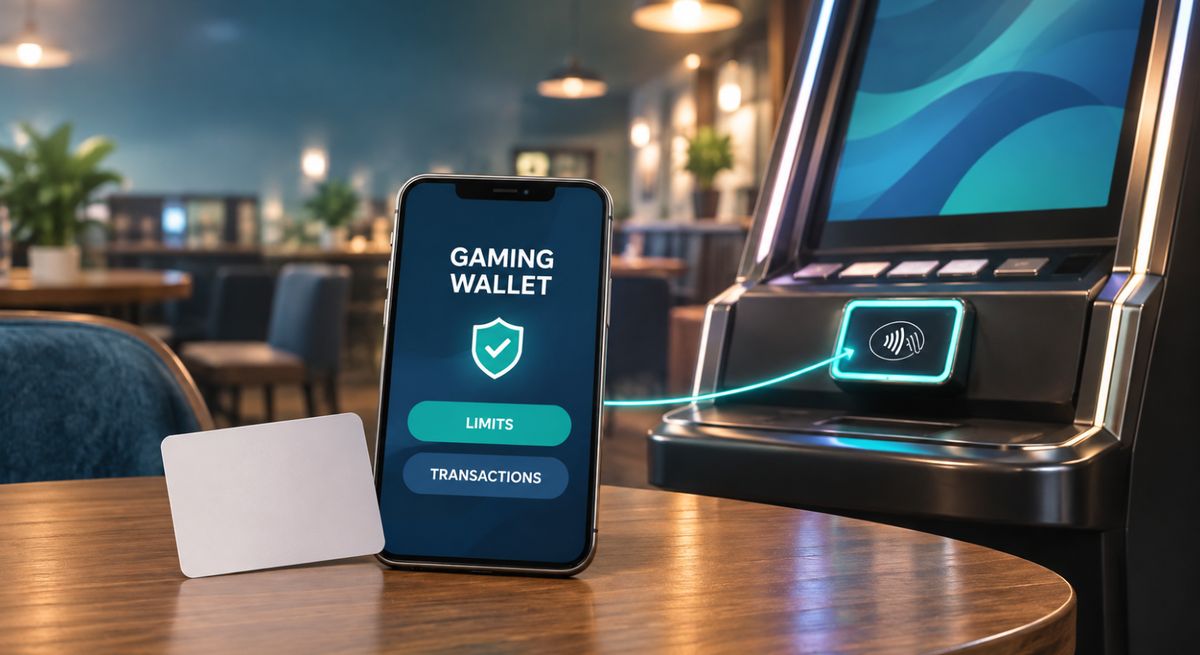
A digital gaming wallet changes how money reaches a poker machine. Instead of inserting banknotes, a player uses a verified account, an app or a compatible card to transfer funds onto an approved machine.
For someone visiting a Sydney pub or club, that can mean identity checks before registration, a connection between a bank account and a gaming wallet, and a transaction history showing money moving in and out. Depending on the system, it can also mean spending limits, activity statements and tools for taking a break.
However, NSW has not simply replaced every note acceptor with a compulsory statewide gambling app. Its main cashless gaming trial ended in September 2024. Participating venues could retain the technology under conditions, and NSW subsequently expanded its framework for controlled digital-payment trials.
That distinction matters. A trial, a recommendation and a statewide legal requirement are different things.
This guide explains how NSW digital gaming wallets work, what players should check before registering, and what the evidence does – and does not – show about cashless pokies.
Information reviewed for November 2026. Availability, payment methods and account conditions vary by approved system and venue.
What Is a Digital Gaming Wallet?
A digital gaming wallet is an account-based payment system used to fund play on compatible land-based gaming machines.
A typical arrangement separates three places where money can sit:
-
Your bank account or another permitted funding source.
-
Your gaming wallet.
-
The credit balance on the poker machine.
Moving money between those balances is not the same as placing a bet.
For example, transferring $40 into a wallet does not necessarily put $40 onto a machine. A second transfer may be required. Likewise, returning unused machine credit to the wallet is not necessarily the same as withdrawing it to your bank.
Understanding those boundaries helps prevent confusion about available funds, completed withdrawals and actual gambling losses.
A digital wallet also does not turn a pub’s poker machines into an online casino. The NSW trials concern payment technology connected to approved machines in licensed land-based venues.
What Happened in the NSW Cashless Gaming Trial?
The main NSW Cashless Gaming Trial ran from March to September 2024 under the oversight of the Independent Panel on Gaming Reform.
The completed trial involved 14 venues – 10 clubs and four hotels – across 12 local government areas. Technology was installed on 2,388 machines.
Its objectives included examining:
-
Whether players and venues would accept the technology.
-
How digital payments might support gambling-harm prevention.
-
Whether traceable transactions could help address money laundering.
-
The operational impact on staff.
-
Infrastructure and implementation costs.
Earlier regulatory sandbox trials were separate projects. These included an Aristocrat system at Wests New Lambton and an IGT system at Club York in Sydney.
Keeping those projects separate is important. Different trials used different products, participating populations and evaluation arrangements. A feature demonstrated at one venue should not automatically be attributed to every NSW digital wallet.
Is Cashless Pokie Play Mandatory in NSW?
The sources reviewed do not establish a universal requirement for every NSW pub and club player to use a digital gaming wallet.
The main 2024 trial used a hybrid model. Participating machines could accept digital payments and/or cash.
After the trial ended, participating venues could choose to retain the technology, subject to monitoring, data collection and oversight by Liquor & Gaming NSW.
In October 2026, the regulator also announced an expanded Innovation Sandbox with a Digital Payments Stream. This allows approved trials of digital payment technologies under specified conditions.
Crucially, permission to conduct a sandbox trial is not permission for unrestricted deployment.
What about the proposed 2028 system?
The reform roadmap recommended mandatory statewide account-based gaming by 2028.
A recommendation is not, by itself, a commenced obligation. Players should not interpret that proposed date as proof that every Sydney pub already requires an account or that a final statewide system has been implemented.
Digital Identity, Player Cards and Wallets Are Different
The phrase “digital pokies card” can describe several things. Separating them makes registration easier to understand.
| Term | What it does | What it does not automatically do |
|---|---|---|
| Identity verification | Establishes who is opening the account | Create a government gambling licence |
| Gaming wallet | Holds funds and records permitted transactions | Work at every NSW venue |
| Physical player card | Provides access to a compatible player account | Contain withdrawable money independently of that account |
| Digital player card | Provides an electronic credential for an approved system | Replace every other identity document |
| Club membership or loyalty card | Supports membership or rewards functions | Necessarily provide gaming-payment access |
| NSW Digital ID | Supports identity verification for participating services | Automatically act as a pokies wallet |
NSW Digital ID is a separate government programme. Its existence does not mean that a gaming wallet is a Service NSW product or that every venue can access government identity records.
Ask the venue to identify the actual wallet provider and explain which services are linked.
How an App-Based Gaming Wallet Works
There is no single registration process covering every approved product. However, the earlier NSW trials illustrate the general sequence.
1. Confirm compatibility
Check that the venue offers an authorised system and identify which machines support it.
Do not assume every machine in a participating venue is compatible, or that the same app works elsewhere.
2. Register and verify your identity
The earlier app-based trials required identity verification.
The expanded trial requirements also included customer due diligence and mechanisms intended to prevent multiple accounts within the same cashless product.
Ask which documents are accepted, who checks them and whether verification happens through the app or with staff.
3. Connect an approved funding source
At Wests New Lambton, participants transferred funds from an external bank account. The Club York trial involved linking an existing bank-account debit card.
Those examples do not establish a universal funding menu. Check the permitted source, transfer timing and any fees before proceeding.
4. Set the available controls
Review spending settings, notifications and other account controls before loading money.
A useful control must be understandable. Find out whether it measures deposits, transfers, losses or playing time.
5. Connect to a compatible machine
The earlier Wests New Lambton and Club York systems used Bluetooth to transfer funds from a smartphone.
Other approved arrangements may use physical or digital cards. Follow the venue’s instructions rather than assuming that an ordinary bank-card tap starts play.
6. End the session and withdraw
Confirm that remaining credit has returned to the correct account.
If you want money back in your bank, complete the separate withdrawal process and check that it has settled.
What a First Visit to a Sydney Venue Might Involve
Imagine arriving at a Sydney club and seeing a “digital wallet available” notice.
The useful first question is not “Where do I tap?” It is “Which system is this, and what do I need to register?”
Staff should be able to explain:
-
Whether participation is optional.
-
Which machines are enabled.
-
Whether a physical card is available.
-
What identity checks apply.
-
How funding and withdrawals work.
-
Where limits and transaction statements appear.
If you planned a short visit, registration may take longer than expected. That is not a reason to rush through privacy notices or load a larger amount to make the process feel worthwhile.
Availability can also change. A venue’s involvement in a historical trial does not prove that the same product is operating there today.
Follow the Money: Bank, Wallet and Machine
The most useful mental model is a three-stage transaction chain:
Bank → gaming wallet → machine credit.
After play, the return route may be:
Machine credit → gaming wallet → bank.
Consider a simplified example:
-
You transfer $60 from your bank to the wallet.
-
You move $20 from the wallet to a machine.
-
You finish with $8 on the machine.
-
The $8 returns to the wallet.
-
Your wallet now holds $48.
Your gambling loss is $12, assuming no fees, other activity or pending adjustments.
It is not $60 because that was the amount initially funded. Nor is it $20 because that was the amount moved onto the machine.
Record the actual bets, prizes and account movements rather than treating every transfer as a loss or withdrawal.
Which Limits Actually Control Spending?
“Limit” is an incomplete description. Several different controls can appear in an account-based system.
Deposit limit
This restricts money entering the wallet over a defined period.
It does not necessarily prevent existing funds or prizes from being wagered again.
Transfer limit
This restricts movement from the wallet to a machine.
Check whether it applies per transaction, session or day.
Loss limit
This measures gambling losses under the system’s definition.
Ask how winnings, refunds, unfinished sessions and other venues are treated.
Time limit
This concerns duration rather than dollars.
A reminder is different from an enforced interruption, so check what actually happens when time expires.
Cooling-off or exclusion control
This restricts access for a period or through an exclusion arrangement.
Confirm its scope. A product-level restriction should not be assumed to cover every venue or payment method.
The key question is: does the control block the relevant activity, or merely display a warning?
Do Not Confuse Historical Trial Caps with Current Universal Rules
The 2024 trial requirements included a $1,000 daily limit on cash top-ups made through the trial technology.
The regulator explicitly stated that this did not apply to other payment methods.
That was therefore not a universal $1,000 daily gambling-loss cap.
Nor should it be treated as the standard allowance for every newer digital-payment trial. Current approvals can involve their own conditions.
The 2026 Digital Payments Stream requires attention to identity verification, funding and spending limits, consumer protection, privacy and record-keeping. Players still need the conditions for the actual product they are using.
Does Cashless Gaming Make Pokies Safer?
A digital account can provide tools that are difficult to reproduce with anonymous cash: transaction records, pre-commitment settings and the potential to connect activity with exclusion controls.
But a payment technology is not automatically a harm-prevention system.
The important questions concern design:
-
Must limits be selected before play?
-
Can a limit be increased immediately?
-
Are transfers deliberate?
-
Can the account draw on additional funds automatically?
-
Do controls follow the player across venues?
-
What happens when a limit is reached?
The 2024 requirements prohibited automatic top-ups, default transfers of the entire wallet balance, and pre-set or suggested transfer amounts.
Those safeguards recognise a basic risk: making payments easier can also remove moments when a person might otherwise reconsider spending.
What Did the Trial Actually Prove?
The completed trial had a substantial installation footprint but very limited player participation.
Of 243 people who registered, only 14 were classified as genuine and active users for the relevant player-data analysis.
That figure refers to users, not venues. There were also 14 participating venues, which can make summaries confusing.
The evaluation said the small sample was insufficient for statistically robust conclusions about the technology’s impact on users.
The appropriate conclusion is therefore limited. The projects provided operational experience and evidence about adoption barriers. They did not establish, through a large representative player sample, that digital wallets reliably reduce gambling harm.
A working payment transfer demonstrates functionality. A demonstrated reduction in harm requires stronger evidence.
Privacy: Who Can See Your Gaming Activity?
Identity-linked payment systems create questions that cash transactions do not.
The NSW trial requirements included trackable movement of funds and the ability to provide relevant player data to Liquor & Gaming NSW and law-enforcement agencies on request.
That should not be confused with how researchers received trial information.
For the evaluation, the regulator states that the Independent Panel and Liquor & Gaming NSW received anonymised findings rather than identifiable participant information.
These are separate data pathways.
Before registering, check:
-
Which organisation holds your identity information.
-
Whether the venue can see identifiable play records.
-
Whether a provider stores data in Australia or elsewhere.
-
How long records are retained.
-
Whether data is used for marketing.
-
What is shared with regulators or other authorised bodies.
-
How to request access, correction or account closure.
“Anonymous research” does not mean the underlying gaming account is anonymous.
Can One Wallet Work Across NSW?
Not necessarily.
The 2024 requirements sought to prevent multiple accounts within each cashless product. That does not establish one interoperable account covering every provider, venue and machine.
Likewise, one app working at two clubs does not prove that it has statewide acceptance.
Ask whether the following travel with you:
-
The wallet balance.
-
Spending limits.
-
Exclusion settings.
-
Transaction history.
-
Identity verification.
Interoperability matters because a limit confined to one product cannot automatically control spending through another.
Future national infrastructure is possible, but Australia’s state and territory regulatory systems mean it should not be assumed.
Lost Phones, Failed Transfers and Account Access
A lost phone or interrupted connection can complicate a session. The priority is to establish where the money is recorded.
If a transfer appears to fail:
-
Stop making additional transfers.
-
Record the time, amount and machine identifier.
-
Check both wallet history and machine credit.
-
Ask staff to identify whether the transaction is pending, completed or reversed.
-
Obtain a support reference before leaving.
Do not send another payment simply to test whether the first one worked.
For a lost phone, ask the provider to secure the account and explain its recovery process. Do not assume the balance is lost, but do not assume staff can release funds without verification either.
Use only the venue’s confirmed support channel.
What Cashless Payments Do Not Change
A digital wallet does not improve a machine’s odds, return-to-player setting or payout distribution merely because the funding method is different.
It does not make a losing sequence more likely to reverse.
It also does not make a displayed wallet balance a sensible spending target.
The same financial distinction applies:
Net cash result = money ultimately recovered − money contributed, with fees and unresolved balances accounted for separately.
If you intended to spend $30, access to another $300 through a linked account should not change that intention.
Frequently Asked Questions
Do I need a NSW government digital identity card to play pokies?
The reviewed sources do not establish a universal requirement of that kind. A gaming product may require identity verification, but that is not the same as mandatory use of NSW Digital ID.
Can I use Apple Pay or Google Pay at any poker machine?
Do not assume so. Acceptance depends on the approved technology and funding arrangements, not simply whether a machine has a contactless-looking reader.
Will my bank transfer be instant?
That depends on the product and payment route. Check both funding and withdrawal timeframes before depositing.
Are digital wallets compulsory in Sydney pubs?
There is no universal requirement established by the sources reviewed. Ask the venue about its current authorised arrangements.
Can a digital wallet stop me overspending?
It may provide useful controls, but their effectiveness depends on definitions, enforcement and scope. A warning or easily changed setting is not equivalent to a binding restriction.
Final Assessment
NSW’s digital gaming wallet projects change the payment experience more clearly than they change the gambling itself.
They can introduce identity verification, account records and spending controls. They can also create confusion about privacy, transfers and which limits genuinely apply.
For players, the best approach is to understand the account before funding it: identify the provider, check the withdrawal route, read the data terms and establish what happens when a limit is reached.
The lasting test of cashless gaming is not whether money moves faster. It is whether the system makes spending more transparent, protects access to remaining funds and demonstrates meaningful reductions in harm.
Sources
- NSW Government: About the Cashless Gaming Trial, including dates, participating venues, technology and evaluation arrangements.
- Liquor & Gaming NSW: Earlier Wests New Lambton and Club York trials, identity checks, bank funding and Bluetooth transfers.
- NSW Government: Trial requirements covering identity, account controls, traceable transfers, cash top-ups and harm-minimisation safeguards.
- NSW Government: Conditions for retaining digital wallet technology after the September 2024 trial.
- Liquor & Gaming NSW: October 2026 announcement of the expanded Innovation Sandbox Digital Payments Stream.
- Independent Panel on Gaming Reform: Roadmap and published evaluation reports.
- ABC News: Trial participation figures, evaluation limitations and the recommended 2028 account-based gaming model.
- NSW Government: Research methodology, anonymisation and handling of trial participant information.
- NSW Government: NSW Digital ID programme and its separate role in identity verification for participating services.