Key Takeaways
Why Licensed Australian Venues Offer Stronger Protection Than Offshore Casinos
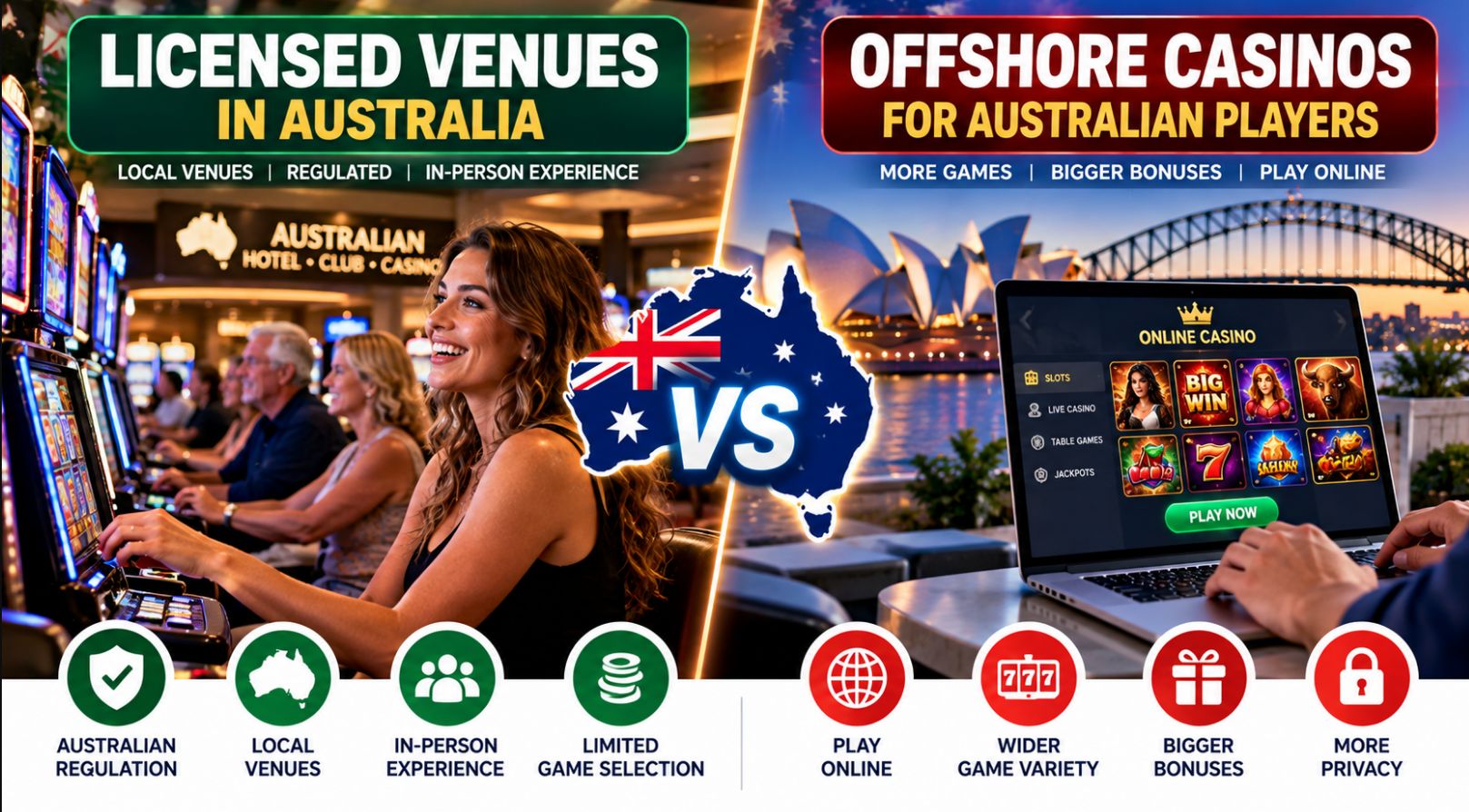
A licensed Australian pub, club or casino offers stronger consumer protection than an illegal offshore online casino. The difference is not a flashy lobby, a familiar logo or a promise of instant withdrawals. It is accountability.
A local gambling venue operates within an Australian regulatory system. Its permissions, gaming equipment and obligations can be checked. Regulators can investigate misconduct and take enforcement action.
An offshore casino targeting Australians may accept your deposit within seconds while leaving you with limited practical recourse when it refuses a withdrawal, disappears or misuses your financial information.
However, calling physical venues “100% safer” would overstate the evidence. There is no defensible percentage that measures this comparison, and no gambling venue is risk-free. Licensed operators can breach rules. Pokies can cause serious financial harm. Australian casinos have faced major penalties for compliance failures.
The accurate message is more useful: licensed physical venues provide an enforceable layer of protection that illegal offshore casino services do not offer Australian customers.
That does not make gambling a good investment. It means that, if you choose to gamble, the identity of the operator and the rules governing its conduct matter far more than a welcome bonus.
The Real Difference Is Accountability
A gambling business should not earn your trust merely because its website looks professional.
The important questions are straightforward:
-
Who operates the business?
-
Is it authorised to provide that gambling service?
-
Which regulator oversees it?
-
What happens if it breaks the rules?
-
Where can you raise a complaint?
Licensed physical venues have identifiable premises and operate under state or territory gambling requirements. In NSW, for example, supplying gambling services and manufacturing, servicing or testing gaming machines require appropriate licences and permissions.
An illegal offshore casino creates a different problem. Its domain may be easy to find, but the legal entity holding your balance can be much harder to establish. A foreign licence may apply to an overseas operation without authorising service to Australians.
Accountability does not guarantee a favourable outcome in every dispute. It does give misconduct a regulatory context beyond whatever the operator’s support team decides to tell you.
That is a substantial consumer-protection advantage.
Licensed Venues vs Offshore Casinos: A Practical Comparison
This is a comparison of protections, not a promise that local gambling produces better financial results.
Why Offshore Online Casinos Are Illegal Services in Australia
Australia distinguishes between types of gambling services.
Online pokies and casino-style games, including blackjack and roulette, are prohibited services when provided to people located in Australia. An overseas operator does not escape that restriction simply by hosting its website elsewhere.
ACMA lists online pokies and casino-style games among illegal online services and warns that they do not provide the same customer protection as licensed services.
Several marketing details can obscure that distinction:
-
An account balance displayed in AUD.
-
Australian flags or familiar slang.
-
Local-looking customer support.
-
A foreign licensing badge.
-
Australian payment options.
-
A website that remains accessible.
None of these establishes Australian authorisation.
The key issue is the service being provided and the customer’s location—not whether the casino appears in a search result.
Likewise, a licensed Australian wagering service should not be confused with a licensed online casino. Permission to offer one gambling category does not imply permission to offer another.
Risk One: Your Winnings May Never Be Paid
The most obvious offshore risk is non-payment.
ACMA warns that illegal operators may accept deposits but prevent customers from accessing winnings. It also identifies situations where operators close or move their services and account balances disappear.
The distinction between losing a bet and being denied payment matters.
A gambling loss results from the game outcome. A withheld balance concerns the operator’s conduct after money is supposedly available to withdraw.
Illegal offshore sites can expose players to both.
A successful small withdrawal does not eliminate the risk. It confirms only that one transaction succeeded under particular circumstances. It does not establish that a larger payment will follow, that the business has adequate funds or that a dispute will be resolved fairly.
A licensed physical venue also needs to process winnings correctly and can encounter disputes. The advantage is not that every payment must be immediate. It is that the venue operates within an identifiable Australian framework of obligations.
That is more meaningful than an “instant cash-outs” banner.
Risk Two: Your Data Can Become Part of the Problem
An online casino account can involve more than an email address.
Depending on its procedures, an operator may request identity documents, address evidence, payment details or financial records. Verification can serve a legitimate purpose, but the sensitivity of the information remains the same.
Before submitting it, the important question is who receives it and what protections apply.
NSW’s GambleAware service warns that illegal gambling exposes not only money but also personal data and financial security. The danger is not proof that every offshore casino steals documents. It is uncertainty about the operator and limited practical protection when something goes wrong.
A licensed physical venue is not immune to data breaches. Casinos and membership programmes may also collect sensitive information.
The difference is therefore not “offline equals private”. It is the presence of a locally regulated business whose identity and obligations are easier to establish.
An encrypted website does not settle this question. A secure connection cannot, by itself, establish that the company receiving the information is trustworthy.
Risk Three: Banking Access Can Be Misused
ACMA identifies unauthorised withdrawals as another risk of illegal gambling providers.
Its warning includes operators continuing to take funds from bank accounts after customers stop using their services. In those circumstances, recovering money can be difficult.
A familiar payment method does not establish a legitimate recipient.
PayID deserves particular caution. AUSTRAC has warned about “PayID pokies” schemes involving nominated accounts, changing payment recipients and misleading branding.
The lesson is not that PayID itself is unsafe. It is that a payment mechanism does not certify the business using it.
The same distinction applies to cryptocurrency. A transfer can work exactly as intended while sending funds to an operator that later refuses payment.
Local gambling still exposes players to spending losses. However, an offshore payment arrangement can add a separate risk involving the recipient, account access and the ability to trace what happened.
Those risks deserve attention before any deposit—not only after a problem appears.
Physical Gaming Machines Face Technical Requirements
A regulated machine is not simply a cabinet with attractive artwork.
In NSW, technical standards cover gaming machines, games, ticket-in-ticket-out systems, in-venue jackpots and communication with the centralised monitoring system.
A new or modified machine must be tested by a licensed testing facility before approval by the relevant authority.
That creates a formal process for evaluating equipment against specified requirements.
It does not mean the machine will pay you back during a visit. Technical approval concerns compliance and operation, not a promise of profit.
The NSW Audit Office explains that gaming machines must meet a minimum theoretical return-to-player requirement of 85%. That percentage applies over the long term.
It does not mean that someone wagering A$100 must receive A$85 back that evening.
A licensed machine can operate correctly while producing substantial losses. Consumer protection and favourable odds are different concepts. Keeping them separate prevents a safety article from turning into misleading gambling promotion.
Complaints Have Somewhere Concrete to Go
At a licensed venue, a complaint begins with an identifiable business.
You can record the premises, date, time, machine or table involved, and the staff member contacted. Relevant receipts or ticket details can help establish the incident.
Regulatory complaint channels also exist.
The Victorian Gambling and Casino Control Commission accepts complaints and asks for details such as the venue, location, dates, people involved and supporting evidence. It may assess, investigate or refer matters according to its remit.
NSW’s gambling regulator also accepts feedback and complaints about licensed businesses.
This does not mean regulators reimburse ordinary losses or guarantee payment in every dispute. Different complaint types may require different channels.
The advantage is access to a defined process and an authority with relevant powers.
By contrast, ACMA warns that Australian regulators cannot help in the same way when an illegal provider treats a player poorly or withholds winnings. Reporting an illegal website can support enforcement, but that is not equivalent to recovering an individual balance.
Harm-Minimisation Duties Are More Than Website Promises
Licensed venues face obligations intended to reduce gambling harm.
The details differ across jurisdictions, but they can include self-exclusion arrangements, incident records and requirements relating to gambling operations.
Victoria provides a clear example. Gaming venue operators must have a self-exclusion programme. Their procedures must address reasonable steps to prevent excluded people entering gaming areas, detection and intervention.
That is an obligation, not merely an optional customer-service feature.
It also has limits. Self-exclusion should not be treated as a perfect barrier or a complete treatment for gambling harm.
An offshore casino may advertise account closure or responsible-gambling tools, but Australians should not assume those features provide equivalent protection. The practical question is whether the operator implements them reliably and what recourse exists if it does not.
Responsible-gambling language is easy to publish. Enforceable duties carry more weight.
Local Venues Are Not Automatically Safe
A credible comparison needs to acknowledge failures on the regulated side.
In July 2023, the Federal Court ordered Crown Melbourne and Crown Perth to pay a A$450 million penalty over anti-money-laundering and counter-terrorism-financing breaches.
AUSTRAC reported serious weaknesses in risk assessments, controls, transaction monitoring and oversight. Crown admitted contraventions of the legislation.
That case does not establish that every venue behaves similarly. It does disprove the idea that a licence eliminates misconduct.
Regulation matters partly because failures can be investigated and penalised. But enforcement is not a substitute for preventing harm in the first place.
The honest argument is therefore not “Australian venues never do anything wrong”.
It is “Australian venues operate within a system that can scrutinise them and impose consequences”.
That distinction protects the credibility of the comparison—and avoids replacing offshore marketing fluff with a different form of overconfidence.
Gambling Harm Remains a Serious Local Risk
Removing illegal-operator exposure does not remove the risk of gambling losses.
The NSW Audit Office reported that gaming-machine profit—the best available measure of losses to patrons—exceeded A$8.4 billion in 2023–24.
That figure is a reminder that compliant machines can still cause substantial financial harm.
A venue’s physical location does not ensure that a player will stay within a budget. Familiar surroundings can make spending feel routine. A licensed operator’s obligations do not guarantee that every intervention works.
The safest financial choice is not to gamble.
For someone who chooses to participate, stronger consumer protection is valuable, but it should sit alongside limits, breaks and willingness to stop.
Do not treat a licensed pub or casino as a place to recover offshore losses. Moving the activity does not change the danger of chasing money already lost.
Not Every Australian Local Pub Has Pokies
An Australia-wide article should not assume that every state has the same venue model.
Western Australia restricts electronic gaming machines to the casino and does not have the pub-and-club gaming-machine network found in other states. The WA Government has reaffirmed that policy distinction.
Elsewhere, permissions and obligations vary by state or territory and venue type.
That means “play locally” is not a universal instruction to visit the nearest hotel and expect gaming machines.
The useful principle is to verify the actual venue and the actual service.
A familiar business name is not enough. Check the relevant state or territory information, and distinguish permission to sell alcohol from permission to operate gambling equipment.
Geographic precision matters because a misleading national generalisation can undermine otherwise sound consumer advice.
How to Check a Physical Venue Before Gambling
Start with accountability, not the size of the jackpot display.
Confirm the Venue’s Status
Use the relevant state or territory regulator’s information to check the venue and applicable permissions.
Make sure the record concerns the right premises and gambling activity. Do not rely solely on advertising.
Understand the Payment Procedure
Ask how winnings are paid and whether different amounts require different procedures.
If there is a dispute, request a clear explanation and retain any ticket or receipt. Do not assume every prize must be paid immediately in cash.
Identify the Complaint Contact
Find out who handles gaming complaints and how to submit one in writing.
A factual record is more useful than a heated conversation without dates, details or evidence.
Check Available Support
Ask about self-exclusion and responsible-gambling assistance.
If you already struggle to control gambling, these resources matter more than the game selection. Attending a venue should not become the default alternative to using an offshore site.
What to Do if an Offshore Casino Has Your Money or Documents
The priority is limiting further exposure.
Stop Additional Payments
Do not send more money to “release” a withdrawal or prove that your account is active.
An unpaid balance should be addressed as a payment issue. Another deposit does not resolve it.
Keep Evidence
Save transaction records, account details, relevant terms and support messages.
Record the website address and claimed company information. If the service moves or closes, those details may become harder to retrieve.
Contact the Relevant Institutions
If you suspect unauthorised transactions or fraud, contact your bank or payment provider promptly and explain accurately what happened.
An authorised gambling deposit and an unauthorised debit are different issues. Do not misrepresent one as the other.
Illegal gambling services can also be reported to ACMA. However, reporting does not guarantee recovery of an account balance.
Protect Remaining Access
If account credentials may be compromised, secure affected accounts and do not reuse exposed passwords.
Never provide banking passwords, one-time security codes, wallet seed phrases or private keys to a purported withdrawal agent.
No legitimate dispute process should require unrestricted access to your finances.
A Better Standard for Gambling Reviews
A trustworthy publisher should evaluate protections before promotions.
For offshore casino coverage, that means stating the Australian legal position prominently rather than hiding it below a bonus table.
It also means avoiding unsupported labels such as “100% safe”, “guaranteed payouts” and “fully legal for Australians”.
For physical venues, the same honesty applies. A review should distinguish licensing, technical compliance, complaint access and gambling-harm risks.
A regulator’s existence does not justify promising that every complaint will succeed. A tested machine does not justify implying that losses are limited. A local address does not eliminate privacy concerns.
The useful question is not which operator has the most persuasive branding. It is which claims can be verified and which protections can actually be enforced.
That approach builds authority by explaining limits—not pretending they do not exist.
Final Verdict: Stronger Protection, Not Zero Risk
Licensed Australian physical venues offer stronger consumer protection than illegal offshore online casinos because they operate within an identifiable local regulatory framework.
That framework includes relevant permissions, equipment requirements, complaint channels and harm-minimisation obligations. Illegal offshore services can expose Australians to withheld winnings, disappearing balances, unauthorised transactions and data risks without equivalent practical protection.
But “100% safer” is not a measurable or supportable claim. Local venues can fail, and gambling losses remain a serious risk.
The sound conclusion is narrower and stronger: avoid illegal offshore casino services, verify any venue you use, and never confuse regulated gambling with risk-free gambling.
For free, confidential support, call Australia’s National Gambling Helpline on 1800 858 858. Assistance is available 24 hours a day, seven days a week. Gambling Help Online also provides support across Australia.
Sources
- ACMA: Illegal gambling services, withheld winnings, disappearing balances and unauthorised withdrawals
- GambleAware NSW: Offshore gambling, personal data and financial-security risks
- NSW Government: Gambling permissions, venue obligations and complaint contact information
- NSW Government: Gaming-machine technical standards, testing and approval
- Audit Office of NSW: Gaming-machine regulation, theoretical RTP and patron losses
- VGCCC: Gambling complaints, evidence requirements and regulatory processes
- VGCCC: Mandatory venue self-exclusion programmes and operator responsibilities
- AUSTRAC: A$450 million Crown penalty and documented compliance failures
- WA Government: Casino regulation and restrictions on gaming machines outside the casino
- AUSTRAC: Illegal online gambling and PayID pokies warning
- Department of Social Services: National Gambling Helpline and gambling support
- Gambling Help Online: Free, confidential support across Australia