Key Takeaways
- Standalone and linked jackpots describe different structures. A standalone jackpot belongs to one machine; a linked jackpot is shared by participating machines.
- “Progressive” means the prize grows through qualifying wagering contributions. Both standalone and linked jackpots can be progressive.
- Local venue links connect a defined group of machines. Wider networks connect machines across a broader approved arrangement.
- Not every nearby machine participates in the same jackpot. Check participation signage and the game’s information screen.
- Jackpot triggers vary. They may depend on a symbol combination, a hidden threshold or a separate random mechanism.
- Betting more can increase the chance per wager in some designs, but it also increases spending. It does not automatically improve value per dollar.
- Mini, Minor, Major and Grand are prize labels—not explanations of the mechanics. A game can mix fixed, standalone and linked prizes.
- After a win, the relevant progressive usually resets to a specified base amount. Other jackpot levels may continue unchanged.
- A jackpot ceiling is not necessarily a “must-win-by” limit. Some systems send further contributions into an overflow amount.
- More machines can mean faster shared prize growth, but that does not automatically improve your individual odds.
- Jackpot payouts follow jurisdiction-specific procedures. In NSW, the portion of a gaming-machine prize above A$5,000 must be paid within 48 hours by crossed cheque or EFT where available.
- A growing meter does not mean a jackpot is due. Understand eligibility, triggers and payout rules rather than chasing the displayed amount.
How Australian Pokie Jackpots Work: Standalone Machines, Local Links and Casino Networks
A jackpot display tells you how much a prize is worth. It does not necessarily tell you which machines contribute to it, who can win it or what triggers the payout.
That distinction matters when you walk into an Australian pub, club or casino.
One machine may have its own growing jackpot. A nearby bank may share a single prize. A casino network may connect machines across a broader approved system. Some games combine linked jackpots, standalone progressives and fixed bonus prizes on the same screen.
The terminology creates confusion. “Linked” describes a connection between machines. “Progressive” describes a prize that increases through contributions. A jackpot can be both.
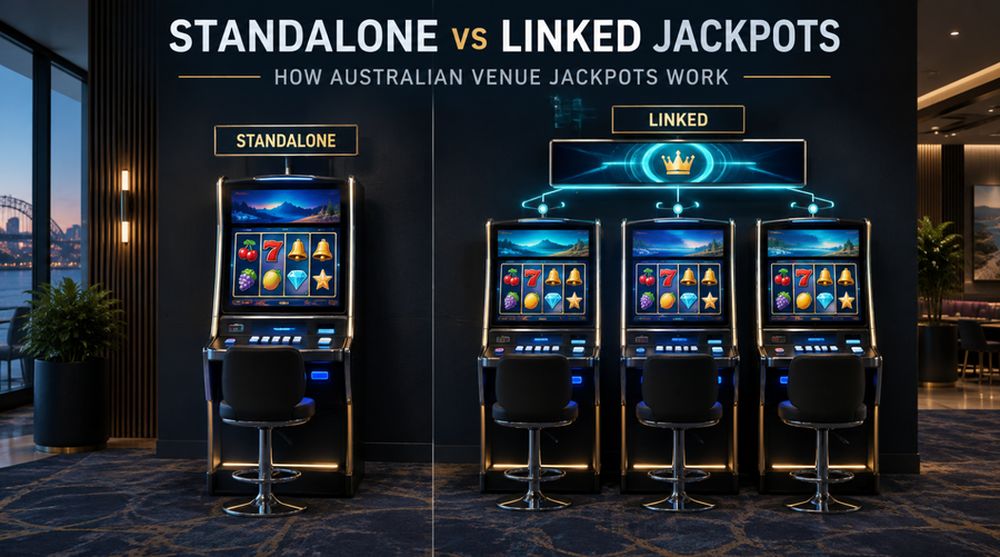
The fundamental difference is straightforward: a standalone progressive belongs to one machine, while a linked progressive is shared by participating machines. A single-venue link and a wider network then differ in the scope of that connection.
None of these labels establishes that a jackpot is easier to win, that a machine is due or that a larger stake offers better value.
This guide explains the mechanics, the money flow and the payout rules behind Australian venue jackpots. The aim is understanding—not a system for beating pokies.
Standalone, Linked and Progressive: Three Different Concepts
The first step is separating jackpot structure from jackpot growth.
A standalone jackpot operates on an individual machine. The Victorian regulator defines standalone jackpot machines as offering incrementing prizes funded and awarded through the operation of that individual game, without being linked to other machines.
A linked jackpot arrangement connects two or more machines to the same jackpot.
A progressive jackpot increases through specified contributions from gambling turnover. It normally begins at a preset amount and resets after being won, according to its approved rules.
These descriptions answer different questions:
-
Standalone: which individual machine operates the jackpot?
-
Linked: which machines share the jackpot?
-
Progressive: how does the prize increase?
A fixed prize does not grow through progressive contributions. It may nevertheless appear beside growing jackpots and carry a familiar name such as Mini or Minor.
The word “jackpot” on its own is therefore insufficient. You need the game rules and the arrangement behind the display.
Quick Comparison of Jackpot Structures
These are structural distinctions. They do not establish universal prize sizes, trigger frequencies or eligibility conditions.
How a Standalone Progressive Works
A standalone progressive, often abbreviated SAP, operates through one machine rather than a shared link.
The prize starts from a specified amount. Eligible wagering adds an increment under the game’s configuration. When the qualifying event occurs, the machine awards the relevant jackpot.
Consider a fictional standalone prize starting at A$500 with a 1% contribution rate.
A A$2 qualifying wager contributes A$0.02. A total of A$1,000 in qualifying turnover contributes A$10, before considering a payout, ceiling or other configuration detail.
The displayed prize would therefore grow from A$500 to A$510 in this simplified example.
Turnover means money wagered, not money deposited. A player can wager the same funds repeatedly after receiving smaller wins, so total turnover can exceed the cash initially inserted.
Other machines do not contribute to this standalone pool.
However, that does not make the accumulated prize the property of the people who helped increase it. Contributions do not create a personal savings account or a right to a future payout.
The prize belongs to whoever satisfies the approved winning conditions.
How a Local Venue Link Works
A linked progressive connects participating machines to a shared jackpot.
The connected games contribute under the arrangement’s approved parameters. A winning event on an eligible machine awards the shared prize.
Imagine a fictional bank of ten machines contributing 1% of qualifying turnover.
If the bank collectively records A$10,000 in qualifying wagers, it contributes A$100 to the relevant pool. Those wagers may come from different players and machines.
The practical difference is shared activity. Your machine’s display can increase while you are not wagering because another participating machine is contributing.
After a linked level is won, that level resets across the relevant arrangement. The exact reset amount follows the configuration.
A link does not necessarily include every machine nearby. Victoria requires participating machines to display signage indicating active participation.
That makes the signage and game information more useful than assumptions based on cabinet placement. Two machines side by side can belong to different arrangements.
Local Links vs Wider Casino Networks
A local link usually covers a defined arrangement within one venue.
A wider-area progressive extends the connection across a broader approved network. That can involve multiple participating locations, depending on the system and jurisdiction.
The underlying principle remains the same: eligible activity contributes to a shared prize, and an eligible winning event awards it.
A larger network can produce more aggregate turnover. That can increase the pace of contributions or the number of winning opportunities across the network.
It does not automatically improve the chance attached to your individual wager.
The distinction is between network activity and personal probability.
Also, “casino jackpot” does not necessarily mean a wide-area progressive. A casino floor can contain standalone machines, local links and other approved arrangements.
Likewise, a pub or club may offer a local link or participate in an authorised broader system. The premises category does not identify the jackpot structure.
Ask which machines and venues participate rather than guessing from the size of the screen.
How the Jackpot Money Is Funded
A progressive has more than one financial component.
The two basic components are:
-
The startup or reset value.
-
The increment generated through qualifying turnover.
Some systems also use secondary or overflow amounts.
A contribution rate describes the share of eligible wagering allocated to the progressive increment. It does not necessarily describe the jackpot’s entire theoretical return.
The startup amount also has mathematical value because it is paid whenever the prize is awarded.
This is why a 1% increment should not automatically be described as “the jackpot contributes 1% RTP”. The complete calculation can include the reset value and the frequency of awards.
The financial records also matter.
Victoria defines a jackpot special prize pool as the funds contributed from wagers on linked machines, from which linked prizes are paid. Its venue requirements address monitoring, reconciliation and treatment of unpaid jackpot funds.
A progressive display is therefore connected to an accounting obligation—not merely an animated counter.
Three Ways a Jackpot Can Be Triggered
Standalone and linked describe the arrangement. Neither tells you how the winning event occurs.
Industry material distinguishes several trigger mechanisms.
Symbol-Triggered Jackpots
A specified symbol combination or game outcome triggers the prize.
The probability depends on the approved game mathematics and applicable eligibility conditions.
A rising jackpot meter does not necessarily change the likelihood of the required combination. The value can increase while the underlying trigger probability remains unchanged.
Mystery or Threshold-Triggered Jackpots
A mystery system can award a jackpot when the progressive passes a hidden trigger value selected under its rules.
A “must be won by” display can indicate this type of arrangement, but the wording and actual rules must be checked.
The winning event may be independent of a special reel combination.
The hidden threshold remains unknown to the player. Watching the meter is not equivalent to knowing the trigger.
Randomly Triggered Jackpots
A random mechanism can determine the award separately from a particular symbol combination.
In some designs, the qualifying chance is proportional to the amount wagered.
That is a design-specific relationship, not a universal rule for every jackpot.
The essential point is that machines with similar jackpot labels can use different trigger systems.
Does Betting More Improve Your Jackpot Chance?
Sometimes the probability changes with the stake. Sometimes eligibility depends on game-specific conditions. The answer must come from the particular rules.
An Aristocrat industry presentation gives examples where jackpot probability increases linearly with the amount bet.
In that kind of design, doubling the stake can double the chance per wager.
It also doubles the money exposed on that wager.
That distinction prevents a common misunderstanding: a higher chance per spin is not automatically better value per dollar.
Other game structures may use different relationships. Australian jurisdictional requirements also matter, so there is no sound national rule that players must always use the maximum stake to win jackpots.
Before wagering, establish:
-
Whether the selected bet is eligible.
-
Which jackpot levels it can access.
-
Whether denomination matters.
-
Whether prize values or probabilities change with stake.
Do not increase spending merely because a display makes the top prize look accessible.
Mini, Minor, Major and Grand Are Labels—not Mechanics
Four named prizes do not necessarily mean four progressives.
A machine can combine:
-
A linked Grand.
-
A standalone Major.
-
Fixed Mini and Minor bonus prizes.
Other configurations can use several standalone levels, several linked levels or a mixture.
Industry examples explicitly show these combinations.
The practical consequence is that each level needs its own explanation.
A fixed Mini might remain at the same value until the relevant denomination or stake changes. A standalone Major might grow from play on that machine alone. A linked Grand might increase through activity elsewhere.
Winning one level does not necessarily reset every other level.
Nor does a familiar title establish that two installations use identical settings.
Read the displayed rules and jackpot information for the actual machine. The marketing names help identify prizes, but they do not explain funding, eligibility or triggering.
What Happens After a Jackpot Is Won?
A progressive normally resets after an award.
The reset is not necessarily zero. It commonly returns to a preset base amount, potentially with other permitted amounts included.
That is why a large prize can be won and the display can immediately show another substantial figure.
A reset also does not establish a mandatory waiting period before the next award. Another jackpot can occur relatively soon where the mechanism permits it.
For a linked level, the reset concerns the relevant shared pool. Other levels can continue under their own rules.
There is an important distinction between an ordinary post-win reset and a technical master reset.
Victoria restricts standalone master resets to circumstances such as restoring a monitoring connection, correcting a fault or commissioning equipment. Operators must also keep relevant records.
A staff member’s technical action is not the same as the normal game process following a win.
A Ceiling Is Not Always a “Must-Win-By” Limit
A jackpot ceiling and a guaranteed award boundary are not interchangeable.
A ceiling can limit the displayed prize while further contributions enter an overflow meter. When the prize is eventually awarded, the overflow can help fund the next cycle according to the configuration.
An industry example describes a prize capped at A$8,888, with A$550 of overflow later added to the next startup amount.
That illustrates one arrangement, not a nationwide standard.
A genuine must-win-by condition concerns when the prize must be awarded under the stated rules.
A capped display may therefore remain at its ceiling without necessarily being overdue.
The Australian/New Zealand Gaming Machine National Standard requires artwork for standalone progressives to explain how contributions are treated after the ceiling is reached.
The useful question is not simply “How high is the meter?” It is “What does this limit mean?”
Why More Machines Do Not Guarantee Better Personal Odds
More participating machines can create more turnover across a link.
That can mean faster aggregate growth and more jackpot activity over time, depending on the mechanism.
It does not mean your individual wager receives a larger share of probability just because the bank is busy.
A player may also see the shared prize reset because someone else won it.
For a fixed-probability trigger, the number of machines does not automatically alter the chance attached to a particular qualifying wager.
Threshold systems require a different explanation because awards relate to the movement through a hidden trigger. Even then, watching a crowded room does not establish who will place the winning wager.
Network-level frequency and individual success are separate concepts.
A jackpot awarded more often across fifty machines is not necessarily easier for one person to win than a different jackpot operating on one machine.
Jackpot Contributions and RTP
Return to player, or RTP, describes a theoretical long-run relationship between wagers and prizes.
Jackpot awards can form part of that return.
The Australian Institute of Family Studies explains that allocating return to rare jackpot events affects the experience of players who do not receive those prizes.
For example, a theoretical total return may include ordinary game awards and a jackpot component. A player who misses the rare jackpot cannot expect their short session to reproduce the total theoretical percentage.
However, not every arrangement funds jackpots identically.
Industry material also describes bolt-on jackpot systems whose return is additional to the underlying game return. It would therefore be inaccurate to claim every jackpot contribution always reduces an existing base-game RTP by the same amount.
The important distinction is between base-game return, jackpot return and total return.
Even a correctly stated total RTP does not guarantee a personal result or tell you how long it will take to encounter a rare prize.
How Jackpot Transparency Is Monitored
Licensed venue jackpots operate within approval and accounting requirements.
Victoria requires venue operators to use approved arrangements, monitor participating machines and reconcile jackpot information.
Its requirements include checking contributions and comparing reported jackpot wins with actual payments. Operators must also account for unpaid funds when arrangements are retired or venue ownership changes.
These controls matter because a jackpot involves both a game outcome and a financial liability.
They do not guarantee that no error can occur. They establish records and obligations against which discrepancies can be investigated.
Different jurisdictions have different systems. A Victorian requirement should not be presented as an identical national rule.
For players, transparency means being able to identify the arrangement, understand eligibility and obtain a clear explanation of a payout—not merely seeing a large number above the machines.
How Jackpot Payouts Work in NSW
A jackpot win does not necessarily mean the entire amount is handed over in cash.
NSW guidance states that, for a prize exceeding A$5,000, the amount above A$5,000 must be paid within 48 hours by crossed cheque or electronic funds transfer where those facilities are available.
If the winner requests the entire prize by cheque or EFT, the venue must do so.
These are NSW gaming-machine payout requirements, not universal Australian casino rules.
Venues also have record-keeping obligations. Clubs must record gaming-machine prize payouts and short-pays.
If a prize is disputed, retain relevant ticket details and note the venue, machine, date, time and explanation provided.
An administrative payout process is different from an operator refusing to acknowledge a valid prize. Knowing the applicable procedure helps distinguish the two.
What to Check Before Playing a Jackpot Machine
Use the information screen and participation signage to establish:
-
Whether each level is fixed, standalone or linked.
-
Which machines participate in the relevant link.
-
Whether the arrangement extends beyond the venue.
-
Which stakes or denominations are eligible.
-
How the jackpot is triggered.
-
Whether a displayed limit is a ceiling or must-win-by condition.
-
What happens after an award.
-
How the venue processes larger payments.
Ask staff for clarification if the display is unclear.
Do not treat previous wins, long gaps or another player’s losses as a reliable prediction. A growing prize is not a personal entitlement, and contributions do not guarantee eventual recovery.
Understanding the system should help you question claims—not encourage you to spend until the jackpot appears.
Final Verdict
Standalone progressives belong to individual machines. Linked progressives share a prize across participating machines. Wider networks expand the arrangement without automatically improving your personal odds.
The most important information sits beneath those labels: eligibility, contribution rates, trigger mechanics, reset values and payout procedures.
A large meter cannot answer those questions by itself.
Licensed approval and accounting requirements support payout transparency, but they do not make jackpot gambling profitable or harmless. Set limits, avoid chasing a supposedly due prize and remember that not gambling is the safest financial choice.
For free, confidential support in Australia, call the National Gambling Helpline on 1800 858 858, available 24/7, or use Gambling Help Online.
Frequently Asked Questions
What is the difference between standalone and linked jackpots?
A standalone jackpot operates on one machine, while a linked jackpot is shared by participating machines. A standalone progressive grows through eligible wagering on that individual machine. A linked progressive receives contributions from qualifying activity across its connected machines.
Are all linked jackpots progressive?
“Linked” and “progressive” describe different aspects of a jackpot. Linked refers to the connection between participating machines. Progressive means the prize increases through qualifying contributions. Check the arrangement’s rules rather than assuming that every prize shown on a linked machine grows.
What is the difference between a local link and a wider jackpot network?
A local link connects a defined group of machines within a venue arrangement. A wider network extends the connection across a broader approved system, potentially involving multiple locations. Neither structure automatically gives an individual player better odds.
Does every machine in a pub or casino contribute to the same jackpot?
No. Machines beside each other can belong to different arrangements, and some may offer standalone jackpots. Check participation signage and the machine’s information screen to establish which machines share the relevant prize.
How are progressive jackpots funded?
Progressive jackpots generally combine a preset startup amount with increments generated through qualifying wagering. Some systems also use secondary or overflow amounts. Turnover means money wagered, not simply money deposited, and the contribution rate does not necessarily represent the jackpot’s entire theoretical return.
What triggers a jackpot win?
The trigger depends on the game and arrangement. It may involve a specified symbol combination, a hidden threshold or a separate random mechanism. The displayed prize amount alone does not reveal the trigger or establish that a win is imminent.
Does betting more improve my chance of winning a jackpot?
It can in some game designs, but the relationship is not universal. A higher stake may increase the chance per wager while also increasing the money exposed. That does not automatically improve value per dollar. Check stake eligibility and the rules for each jackpot level.
What happens to the jackpot after someone wins?
The awarded progressive level normally resets according to its rules, usually to a specified base amount rather than zero. Other jackpot levels may continue unchanged. A reset does not necessarily create a minimum waiting period before another win.
Are Mini, Minor, Major and Grand jackpots always progressive?
No. These names identify prize levels, not their mechanics. A machine can combine fixed Mini and Minor prizes with a standalone Major and a linked Grand. Each level needs to be checked separately for funding, eligibility, triggering and reset conditions.
Does a large jackpot mean the machine is due to pay?
No. A growing meter does not establish that a jackpot is due, and previous players’ losses do not create an entitlement to the next prize. A ceiling also differs from a genuine “must-win-by” condition. Check the stated mechanism rather than treating the displayed amount as a prediction.
Sources
- VGCCC: Standalone and linked jackpot definitions, participation signage, accounting, resets and unpaid funds
- Australian Institute of Family Studies: Gaming-machine mechanics, progressive contributions and RTP
- Australian/New Zealand Gaming Machine National Standard: Progressive prizes, reset values and ceiling disclosures
- Aristocrat industry presentation: Jackpot structures, triggers, stake relationships, overflow and RTP components
- NSW Government: Gaming-machine prize payments, larger payouts and record keeping
- NSW Gaming Machines Regulation: Authorised linked-system distinctions and applicable requirements
- Department of Social Services: National Gambling Helpline and Australian support services
- Gambling Help Online: Free, confidential gambling support