Key Points
- The social appeal starts with the meal, not the machines. RSL bistros can provide somewhere for friends, families and different generations to spend time together.
- You do not need to gamble to enjoy the visit. Dining, coffee and conversation can make a complete outing.
- Affordability varies. Check current menu prices, seniors’ eligibility, member discounts and surcharges rather than assuming every club meal is cheap.
- Family-friendly facilities differ between venues. A children’s playroom does not necessarily include supervision or childcare.
- Keep family dining separate from gambling. Children’s facilities should not become a reason for adults to extend a gaming session.
- An RSL club and an RSL sub-branch are not necessarily the same organisation. Club membership or spending does not automatically support the RSL charity.
- Assess community contributions through named programmes and published information – not branding alone. You do not need to play pokies to support veterans.
- Online casinos cannot replicate a shared meal or physical gathering place, but that does not make local gambling risk-free.
- Choose the venue for its hospitality, respect anyone who declines gaming and keep the outing worthwhile without a single wager.
More Than Pokies: Why Australians Meet at the Local RSL for Food, Family and Connection
The strongest reason to visit a local RSL is usually not the jackpot display. It is the table where everyone can sit down together.
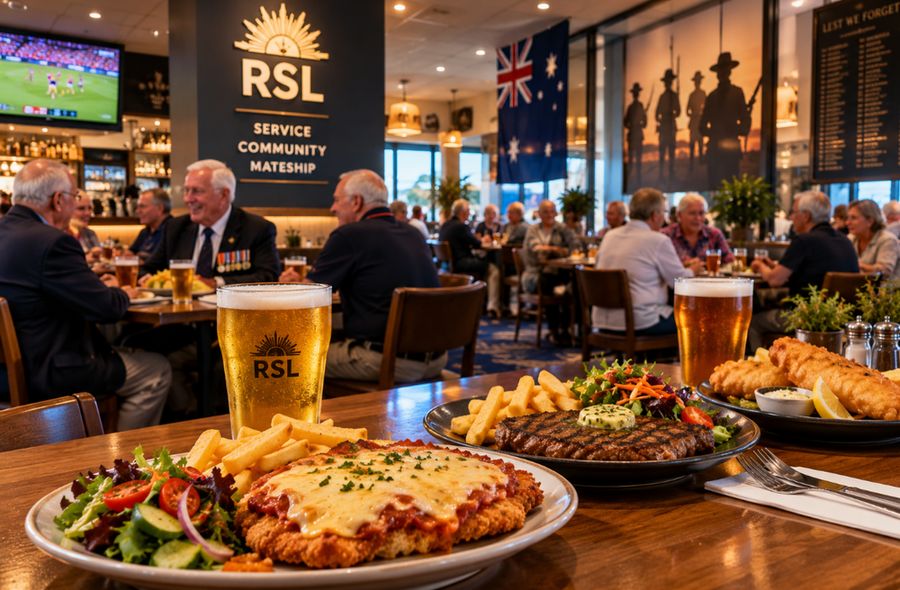
A family lunch. A catch-up with an old mate. A seniors’ meal followed by a conversation that lasts longer than the coffee. For many Australians, the appeal of the local club is practical: food, seating and familiar surroundings in one place.
An online casino cannot provide those experiences. It can offer games and digital interaction, but it cannot cook dinner, accommodate a birthday lunch or provide a physical meeting place.
However, the bistro and the pokie room should not be treated as the same attraction.
You can enjoy the hospitality without gambling. Families should be able to focus on dining and conversation without making gaming part of the occasion. Community involvement also deserves examination rather than an assumption that every dollar spent benefits veterans.
This review explores why the RSL-style outing retains its appeal, what affordable dining actually looks like, and how to assess a club beyond its gaming facilities.
It draws on published venue information rather than claiming personal visits. Menus, facilities and admission conditions can change, so check the relevant club before travelling.
The Social Tradition Starts With Gathering, Not Gambling
RSL Australia traces the origins of many licensed RSL clubs to sub-branches that provided veterans and their families with places to gather.
That history helps explain the enduring emphasis on shared space.
The dining room, lounge and meeting table are not incidental to the experience. They provide somewhere to spend time together rather than simply purchase a product and leave.
Over time, some clubs became larger hospitality operations and separated from the RSL structure. Others retain different relationships with their local sub-branches.
The result is a varied landscape rather than one uniform national model.
For visitors, the important question is what the particular venue offers today. Does it provide a comfortable dining experience? Can people who do not gamble enjoy the visit? Are community activities identifiable?
A club’s history can explain its identity. It does not automatically establish the quality of its current hospitality or the destination of its revenue.
An RSL Club and an RSL Sub-Branch Are Not Always the Same
This distinction is essential.
RSL Australia describes sub-branches as membership-based, not-for-profit communities supporting veterans through activities such as connection, welfare, advocacy and commemoration.
Licensed RSL clubs are hospitality venues. Most are separate entities from the League, although arrangements differ between states.
In NSW, RSL Australia states that neither RSL NSW nor its sub-branches owns or operates registered clubs, sells alcohol or facilitates gambling.
Queensland also has independent RSL clubs alongside sub-branches, including some sub-branches operating hospitality facilities.
The practical implications are straightforward:
-
A club membership is not necessarily membership of the RSL charity.
-
Buying dinner does not automatically constitute a donation to veterans.
-
Playing pokies should not be presented as a charitable obligation.
-
A club’s support for a sub-branch needs to be established individually.
These distinctions do not diminish genuine community contributions. They make those contributions easier to understand accurately.
Why the Bistro Can Be the Main Attraction
A useful club bistro solves an ordinary problem: finding somewhere a mixed group can eat without making the booking unnecessarily complicated.
A family might need children’s meals, a vegetarian option, an early sitting and somewhere comfortable for grandparents.
A group of friends might want different dishes without booking separate restaurants.
Published venue information shows how some RSLs approach this.
Phillip Island RSL describes a 220-seat Lone Pine Bistro, a terrace overlooking a native garden and a children’s playroom. Its menu includes family favourites, seasonal dishes and options marked for different dietary preferences.
Katoomba RSL’s Red Poppy Brasserie advertises steaks, burgers, schnitzels, fish, salads, pizzas and children’s combinations, alongside vegan, vegetarian and gluten-free options.
Those examples illustrate breadth, not a guarantee that every RSL has the same facilities.
The best bistro is the one that meets the needs of the people attending. A large gaming floor cannot compensate for unsuitable food, uncomfortable seating or an inaccessible dining room.
Affordable Meals: Read the Menu Before Believing the Reputation
The phrase “cheap club meal” needs scrutiny.
A venue can provide value without being inexpensive across the entire menu. Premium steaks, seafood dishes, drinks and extras can move the total well beyond a casual budget.
Phillip Island RSL’s published 2026 menu provides a useful example.
Its children’s meals are listed at A$13 or A$14 and include a small vanilla soft-serve ice cream. Its seniors’ section lists several mains at A$19, including roast of the day, chicken schnitzel and selected pasta dishes.
However, the regular menu lists chicken schnitzel at A$27 and chicken parmigiana at A$30. Higher-priced grill and seafood options are also available.
That is not a criticism of the venue. It demonstrates why affordability depends on the actual order and eligibility.
The seniors’ menu requires a Seniors Card. Public-holiday surcharges also vary by membership category.
These are published examples, not a promise that prices remain unchanged.
What a Family Meal Might Actually Cost
A menu becomes more useful when you translate it into a table total.
Using Phillip Island RSL’s published prices, a fictional order of two A$27 chicken schnitzels and two A$13 children’s meals totals A$80 before drinks or other charges.
Two eligible seniors ordering A$19 mains would pay A$38 before extras.
These examples are not equivalent offers: one is a family order and the other depends on seniors’ eligibility.
They demonstrate why “affordable” should mean a predictable total rather than a vague reputation.
Before booking, check:
-
Current menu prices.
-
Member and visitor differences.
-
Eligibility for seniors’ meals.
-
Public-holiday surcharges.
-
Charges for sides, sauces or substitutions.
-
Whether a promotion applies to your preferred sitting.
A discounted meal also stops being inexpensive if the outing leads to unplanned gambling losses.
Keep dining value and gaming expenditure separate. There is no need to “support the club” by spending beyond the meal you wanted.
Family-Friendly Dining Does Not Make Gambling a Family Activity
Children’s menus and play facilities can make a dining venue more practical.
They do not make the gaming room an appropriate part of a family outing.
Phillip Island RSL advertises a children’s playroom. Katoomba RSL also publishes information about a dedicated children’s area.
Parents should still check supervision requirements, suitability and the relationship between those facilities and the dining area. Do not assume that a playroom includes childcare.
The broader issue is exposure.
A 2026 NSW Office of Responsible Gambling campaign highlights the influence parents and carers have on children’s attitudes towards gambling. Its advice includes not gambling in front of children, not helping them gamble and discussing the risks.
For families, the sensible focus is the meal and time together.
A play area should not become a reason to leave children occupied while adults extend a gambling session. Family-friendly hospitality and adult gaming need clear boundaries.
What the Physical Club Atmosphere Adds
The clearest advantage over an online site is shared physical space.
At a dining table, everyone participates in the same occasion. Food arrives, conversation moves between people and the visit has a purpose beyond a screen.
A venue can also accommodate different levels of participation. Someone may want a full meal, another a coffee, and another simply a place to sit with the group.
Published examples include Phillip Island RSL’s lounge, library, terrace and dining facilities, and Katoomba RSL’s café and brasserie.
These facilities do not prove that every visit will feel welcoming. Service, noise and comfort remain venue-specific.
But they illustrate an important distinction: the social experience exists independently of whether anyone places a bet.
That is the strongest basis for choosing a club as an outing. The venue should earn its place through hospitality rather than requiring gaming to make the visit worthwhile.
The Pokie Room Is an Optional Facility, Not the Social Centre
Some visitors enjoy gaming, but its presence should not define every club visit.
The bistro and the pokie room serve different purposes. One provides a meal and a setting for conversation. The other provides gambling.
Treating the two as inseparable risks making participation feel expected.
A friend should be able to decline gaming without being left alone or pressured to join. A group outing should not depend on everyone spending money on machines.
For adults who choose to gamble, a clear spending and time limit helps keep that choice separate from the dinner plan. It does not eliminate risk.
Do not extend the session because the meal was good, because friends are still playing or because a win seems overdue.
The better measure of a social outing is whether everyone enjoyed being together—not whether the machines paid.
Community Contributions: Look for Specific Evidence
Some clubs publish identifiable community-support programmes.
Phillip Island RSL invites eligible local organisations to apply for grants supporting equipment, resources and activities intended to encourage social inclusion and community connection.
Redlands RSL publishes a community grants programme offering eligible organisations funding of up to A$5,000 for specified purposes.
NSW venues also describe participation in ClubGRANTS, with categories addressing community welfare, services and other eligible activities.
These examples provide something concrete to examine.
However, they do not establish that every club contributes equally, that all revenue supports charity or that gambling losses become an unqualified community benefit.
Look for named recipients, programme criteria and reporting periods. Distinguish a completed contribution from an invitation to apply.
If veteran support is the reason you want to contribute, contact the relevant sub-branch or organisation directly about suitable ways to help.
You do not need to gamble to express that support.
Club Membership: Useful Only if the Benefits Fit
A membership offer can be worthwhile when its practical benefits match how you use the venue.
But admission and membership are not nationally uniform.
RSL Australia explains that clubs determine membership conditions, with state licensing laws and local rules governing entry. Membership of the League does not automatically confer access to a licensed club.
Membership at one club also should not be assumed to provide entry or discounts elsewhere.
Before joining, ask:
-
What does membership cost?
-
Which dining benefits apply?
-
Are discounts available on the days you visit?
-
Are there exclusions or separate eligibility requirements?
-
Does membership renew automatically?
-
What visitor arrangements apply to your group?
Calculate value from the benefits you would genuinely use.
Do not count gaming-linked rewards as savings unless you account for the spending required to obtain them. Spending more than planned to earn a discount defeats the point.
A Visitor’s Checklist for Choosing a Local RSL
| What matters | What to check | Why it matters |
|---|---|---|
| Meal value | Current prices, eligibility and surcharges | Keeps the table total predictable |
| Family facilities | Play-area suitability and supervision rules | Avoids assuming childcare is provided |
| Dietary needs | Ingredients, substitutions and kitchen advice | Menu labels may not resolve every requirement |
| Comfort | Seating, noise and quieter dining areas | Supports conversation |
| Access | Entry route, toilets and mobility arrangements | Helps everyone participate |
| Admission | Membership, identification and guest rules | Prevents surprises at the door |
| Non-gambling activities | Dining, café, lounge and scheduled events | Makes the outing worthwhile without gaming |
| Community claims | Named programmes and recent reporting | Separates evidence from branding |
Not every venue will excel in every category.
Choose according to the people attending rather than the size of the building or gaming floor.
Two Examples of the Hospitality-First Approach
Phillip Island RSL, Victoria
Phillip Island RSL’s published information presents several reasons to visit beyond gaming.
The Lone Pine Bistro has indoor dining, a terrace and a children’s playroom. Its menu includes children’s and seniors’ sections, while the wider venue lists a lounge and library.
Its community grants programme also provides identifiable information about eligible local support.
The limitation is that published facilities do not establish service quality on a particular day. Menu prices, availability and booking conditions need checking.
Katoomba RSL, NSW
Katoomba RSL’s Red Poppy Brasserie advertises a broad Modern Australian menu with dietary options and children’s combinations.
Its café provides an alternative to a full meal, while its website identifies a children’s area.
That can suit groups whose needs do not revolve around gaming.
Again, this is an assessment of published offerings—not a personal restaurant review or a claim that every visit delivers the same experience.
Why an Online Casino Cannot Replace This Outing
An online casino can provide games on a device. It cannot supply the physical components of a club lunch.
There is no shared meal, children’s dining arrangement, accessible table or opportunity to spend an afternoon together in the same room.
Digital interaction may be meaningful in other contexts, but it is a different experience.
The legal distinction also remains important. Offshore operators cannot lawfully provide online casino-style services to people located in Australia. Familiar branding or an AUD account does not change that.
Licensed physical venues operate within state or territory requirements, but they still carry gambling risks.
The strongest alternative to solo online gambling is not necessarily local gambling. It may be meeting friends for lunch and leaving the machines out entirely.
That approach preserves the social benefit without making a wager the price of admission to companionship.
The Limits of “Community” as a Safety Claim
Familiarity can feel reassuring, but it is not a guarantee.
A friendly employee, a familiar dining room or a history of local involvement does not remove the risks associated with pokies.
GambleAware’s NSW information identifies harm from both personal gambling and another person’s gambling. It also associates frequent gambling with higher risk.
That is why community language needs balance.
A club can provide worthwhile hospitality and support local organisations while gambling causes harm to some patrons and families. Those realities can coexist.
Avoid treating the RSL name as proof that gaming is harmless, patriotic or socially necessary.
The more credible standard is whether the venue supports a good visit without pressuring people to gamble—and whether you can comfortably choose not to participate.
For anyone struggling with gambling, a non-gaming restaurant or other setting may be a better choice.
How to Plan a Genuinely Social Visit
Start with an activity: lunch, coffee, a birthday meal or a conversation.
Choose the venue because it fits that purpose.
Book where appropriate, confirm any dietary or accessibility needs and tell the group what the plan includes. If children are attending, keep the occasion centred on dining and suitable non-gambling activities.
Set a total outing budget before adding optional purchases.
If someone wants to leave after the meal, respect that. If someone does not want to enter a gaming area, do not make them justify it.
Most importantly, do not let one person’s gambling determine everyone else’s schedule.
A successful visit has a straightforward test: would it still have been worthwhile if nobody played a machine?
If the answer is yes, the hospitality is doing its job.
Final Verdict: The Table Matters More Than the Machines
The enduring appeal of the local RSL-style outing is connection: somewhere to share a meal, accommodate different generations and spend time together.
Published examples show how bistros, cafés, play facilities, lounges and community programmes can support that role.
But affordability needs checking, charitable claims need evidence and family-friendly dining needs separation from gambling.
The tradition is strongest when participation does not depend on playing pokies.
Choose the club for its hospitality, respect the people who decline gaming and remember that a meal with mates can be a complete outing on its own.
For free, confidential gambling support in Australia, call 1800 858 858, available 24/7, or contact Gambling Help Online.
Frequently Asked Questions
Why do Australians still visit their local RSL club?
The appeal often extends beyond gambling. RSL clubs can provide bistros, cafés, lounges and other spaces where people meet for meals and conversation. Facilities vary, but the strongest social attraction is a shared physical gathering place—not the need to play pokies.
Can I visit an RSL bistro without playing the pokies?
Yes. Dining and gambling are separate activities, and a meal or coffee can be the entire purpose of your visit. Check the venue’s admission requirements before travelling, as membership, identification and guest arrangements differ between clubs.
Are RSL bistro meals always cheaper than restaurant meals?
No. Affordability depends on the menu, your eligibility for discounts and any additional charges. Children’s meals and seniors’ options may offer value, while premium dishes and drinks can increase the total. Compare the actual order rather than assuming every club meal is inexpensive.
Are RSL clubs suitable for families with children?
Some clubs offer children’s menus, playrooms and family dining areas. Those facilities are venue-specific, so check suitability and supervision requirements beforehand. Family-friendly hospitality should remain separate from gambling, with the visit centred on food and appropriate non-gambling activities.
Does a children’s playroom include childcare?
Not necessarily. An advertised playroom does not establish that trained staff supervise children or provide childcare. Ask the venue about its rules and your responsibilities before relying on the facility.
Is an RSL club the same as an RSL sub-branch?
Not always. RSL sub-branches are community organisations supporting veterans through activities such as welfare, advocacy and commemoration. Licensed RSL clubs are hospitality venues, and many operate as separate entities. Their relationships vary by state and organisation.
Does spending money at an RSL club automatically support veterans?
No. Do not assume that a meal, membership payment or gambling expenditure constitutes a donation to veterans. Look for specific information about the club’s contributions and relationship with its local sub-branch. If veteran support is your goal, contact the relevant organisation directly about ways to help.
Do I need membership to eat at an RSL bistro?
Admission conditions vary. Some venues have visitor or guest arrangements, while others apply particular membership and identification requirements. Membership of the RSL charity or another licensed club should not be assumed to provide automatic entry or dining discounts.
How can I choose an RSL for a social outing?
Check the current menu, total meal cost, booking arrangements, accessibility and seating. If children are attending, confirm suitable facilities and supervision rules. Prioritise a venue where everyone can enjoy the occasion without entering the gaming area.
How can I keep an RSL visit focused on socialising rather than gambling?
Plan around a meal, coffee or conversation, and agree on the purpose of the visit beforehand. Respect anyone who declines gaming and avoid letting a gambling session determine the group’s schedule. A useful test is whether the outing would still be worthwhile if nobody played a machine.
Sources
- RSL Australia: Club history, sub-branch distinctions, membership and state differences
- RSL Queensland: Clarifying the relationship between licensed clubs and the RSL charity
- Phillip Island RSL: Bistro, terrace, playroom, lounge and dietary offerings
- Phillip Island RSL: Dining and booking information
- Phillip Island RSL: Published 2026 menu, children’s meals, seniors’ eligibility and surcharges
- Katoomba RSL: Red Poppy Brasserie menu categories and dietary options
- Katoomba RSL: Café offerings
- Katoomba RSL: Published children’s-area information
- Phillip Island RSL: Community grants programme and eligibility
- Redlands RSL: Community grants programme
- Cardiff RSL: ClubGRANTS categories and application information
- NSW Government: Parental influence and reducing children’s exposure to gambling
- GambleAware NSW: Gambling harm and risk information
- ACMA: Australian restrictions on online casino services
- Gambling Help Online: Free, confidential Australian support