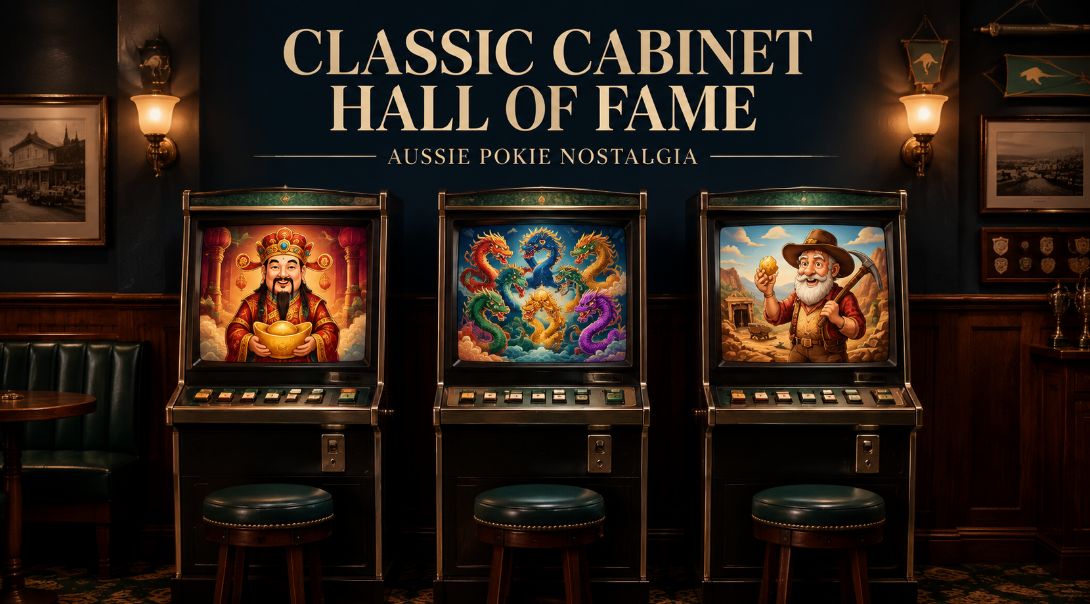
Key Takeaways
- Classic Aussie pokies such as Choy Sun Doa, 5 Dragons and Where’s the Gold stand out for their recognisable characters, distinctive features and lasting legacy.
- Queen of the Nile and Adonis also deserve recognition for their place in Australian venue-gaming history.
- A familiar title does not guarantee the original experience. Modern remakes can change bonus features, jackpot structures and cabinet presentation.
- Older machines are not automatically more generous. Nostalgia, cabinet age and past wins do not establish better odds.
- Looking for a particular retro game? Confirm the exact edition and current availability with the venue before visiting.
- Appreciate the history without chasing past results. Set spending and time limits if you choose to play.
Classic Aussie Pokies: The Iconic Games Behind the Nostalgia
A familiar pokie does not need a towering screen to catch someone’s attention.
Sometimes it takes a smiling God of Wealth, five coloured dragons or a cartoon prospector. For seasoned Australian venue visitors, those images identify a generation of games whose personalities were built around recognisable symbols and distinctive free-game features.
Choy Sun Doa, 5 Dragons and Where’s the Gold belong at the centre of that conversation. Queen of the Nile and Adonis also deserve a place in a broader retrospective.
Their legacy is visible in more than nostalgia. Manufacturers continue to revisit these names through updated games, collections and jackpot families. Australian approval records also show familiar titles associated with newer hardware platforms.
However, a classic title and a classic cabinet are not the same thing.
An old favourite can appear on a newer machine. A familiar name can belong to a substantially revised game. A modern remake may preserve the artwork while changing features, prize structures and presentation.
This hall of fame separates those layers. It celebrates recognisable design without pretending older pokies were more generous, that every remembered machine remains available, or that nostalgia can predict a payout.
The objective is identification and understanding—not a reason to chase an old winning session.
What Qualifies a Pokie as a Classic?
There is no official national threshold for “classic” status.
For this review, the term describes a game with a recognisable identity and a documented legacy beyond its original presentation.
The strongest candidates offer several things:
-
Artwork or characters that remain identifiable.
-
A feature associated with the game’s name.
-
Evidence of later redevelopment or continued recognition.
-
A place in Australian venue-gaming history.
This is an editorial selection, not a popularity ranking based on nationwide machine counts.
That limitation matters. A player may remember one title from a regional club while another associates a different game with a suburban casino floor. Neither memory establishes current national availability.
The best evidence of longevity is specific: manufacturer descriptions, dated industry coverage, historical records and regulatory documents.
Those sources can establish a continuing legacy. They cannot tell you which machine is operating at the venue down the road tonight.
The Hall of Fame at a Glance
| Game | Recognisable identity | Why it belongs here | Main identification trap |
|---|---|---|---|
| Choy Sun Doa | God of Wealth imagery and free games with Wild multipliers | Continued manufacturer recognition and later redevelopment | Confusing the earlier game with Jackpot Carnival Deluxe |
| 5 Dragons | Dragon imagery and a choice-based free-games identity | An extensive family of later versions and an Australian approval trail | Treating Gold, Deluxe, Reign and other editions as identical |
| Where’s the Gold | Cartoon mining theme and character selection | A distinctive feature carried into later adaptations | Mixing the original with linked or jackpot-branded versions |
| Queen of the Nile | Egyptian imagery and established video-pokie heritage | Historical records date the game to 1997 | Assuming every installation uses original hardware |
| Adonis | Classical imagery and multiplier-based free games | Recognised as an older title redeveloped for newer audiences | Applying remake features to every earlier version |
The titles are the starting point. The version and hardware still need checking.
Choy Sun Doa: A Character Stronger Than the Cabinet
Choy Sun Doa’s most memorable asset is its central character.
The smiling God of Wealth gives the game an identity that remains recognisable across different presentations. The theme combines that figure with imagery associated with wealth and good fortune.
Aristocrat’s Winners Collection description identifies free games awarded through scatter wins, with Wild multipliers contributing to the feature.
That is the useful mechanical foundation for a retrospective: a recognisable character connected to an identifiable bonus idea.
Why It Earns Its Place
Choy Sun Doa does not depend solely on a generic treasure theme. Its title, character and feature work together.
That coherence helps distinguish it from games whose artwork can be changed without materially changing their identity.
Its later redevelopment also provides evidence that the name retained commercial relevance.
What Has Changed?
Jackpot Carnival Deluxe is not simply the earlier game with sharper graphics.
Industry coverage describes Choy Sun Doa within that family offering a choice between eight free games with extra reveals and a Jackpot Carnival Spin feature. The wider family adds Cash on Reels, Hammer and Spin-a-Winna mechanics.
Those additions need to be treated as version-specific.
Verdict: Choy Sun Doa belongs in the hall of fame for character recognition and a lasting feature identity—not because every edition plays the same way.
5 Dragons: A Classic That Became a Family
5 Dragons illustrates how a memorable original can develop into a much broader franchise.
Its identity centres on dragons and a choice-based free-games feature. Later versions retain that association while adding different presentation and bonus systems.
Aristocrat’s current catalogue includes 5 Dragons Gold, Ultra, Riches and Reign, among other variations.
The manufacturer describes 5 Dragons Riches as combining Deluxe and Gold content in one cabinet. Its Reign description identifies additional respin and sticky-Wild features.
Those differences are not cosmetic footnotes. They affect what a returning player encounters.
The Australian Continuity Evidence
An ACT approval instrument dated August 2025 lists 5 Dragons among previously approved games regression-tested with supporting software on the Gen10 Baron platform.
That is stronger evidence than a vague claim that the game “is still everywhere”.
It establishes a specific approval event connecting the title with newer platform software. It does not establish how many venues installed it.
What to Check
Ask which edition is present, then inspect the information screen.
Do not import a feature table, RTP figure or stake range from an online review of another version.
Verdict: 5 Dragons earns recognition both as an identifiable classic and as an example of how legacy names evolve. The franchise history makes accurate version identification more important, not less.
Where’s the Gold: Personality Through Character Selection
Where’s the Gold stands out because its mining theme does more than decorate the reels.
Its character-selection feature gives the bonus an identifiable moment: the player chooses a character associated with a particular free-game and symbol arrangement.
The Drop’s retrospective on Jackpot Carnival Deluxe explicitly describes that selection as retaining the original game’s feature foundation.
It reports three scatters triggering free games, followed by a character choice associated with between three and ten free games and specified symbols.
Why It Remains Memorable
The game offers a clear narrative: prospecting, choosing a character and watching the feature unfold.
That is different from remembering only a prize meter.
A distinctive interaction can remain familiar even when graphics and cabinets change.
Where Confusion Begins
Where’s the Gold now appears in multiple contexts.
ACT records include Cash Express Luxury Line versions, while Aristocrat’s overseas catalogue includes Where’s the Gold? Jackpots titles with bonus-wheel and progressive-multiplier features.
Those products should not be merged into one universal specification.
Verdict: Where’s the Gold earns its place through personality and an identifiable feature. Anyone searching for the original experience should ask about the exact version rather than accepting the name alone.
Queen of the Nile: A Historical Benchmark
Queen of the Nile provides an older reference point for the hall of fame.
Historical gaming records date its release to May 1997 and identify Aristocrat MK5 hardware. They also record later appearances on MK6 and MK7 platforms.
That history makes it useful for understanding why software and cabinets should be discussed separately.
A title can move across hardware generations while retaining a familiar identity.
Why It Matters
The Egyptian theme places Queen of the Nile within a recognisable strand of video-pokie design: a strong central setting, legible symbols and a named game identity.
Its historical documentation also gives the retrospective a firmer chronology than a collection of remembered release dates.
What the History Does Not Prove
A historical listing does not establish current installation at a particular Australian venue.
Nor does an early release date prove that every surviving version has the same configuration, denomination or theoretical return.
Avoid the leap from “well-known old game” to “unchanged machine”.
Verdict: Queen of the Nile belongs as a historical benchmark. Its value here is the documented longevity of the title—not an unsupported claim that it remains nationally available in original form.
Adonis: A Legacy Name With a Modern Afterlife
Adonis deserves an honourable place alongside the three headline favourites.
Industry coverage identifies it as one of Aristocrat’s older games redeveloped within Jackpot Carnival Deluxe.
The article describes that adaptation’s free games as using Wild multipliers, with multipliers capable of accumulating on a line win.
That is information about the discussed version, not a licence to attach every detail to the original.
Why Include It?
Adonis illustrates a recurring development strategy: preserve a recognisable title and visual identity, then integrate it into a contemporary family.
For returning players, that can create familiarity without exact equivalence.
For reviewers, it creates a responsibility to distinguish heritage from specification.
Verdict: Adonis earns recognition for its documented place in the legacy catalogue. It also demonstrates why a hall-of-fame article should avoid presenting modern feature additions as original mechanics.
Classic Game, Classic Cabinet: What Is the Difference?
The game is the software and associated rules. The cabinet is the physical presentation and control platform.
A genuine retro setup may combine older software with an older machine. But several other combinations are possible:
-
A classic title on later hardware.
-
A revised edition on a familiar cabinet.
-
A multi-game collection containing a legacy name.
-
A jackpot adaptation with additional mechanics.
The ACT’s 2025 approval record provides a concrete example by listing 5 Dragons and Cash Express Luxury Line SAP – Where’s the Gold in connection with Gen10 Baron supporting software.
That does not make those products original-era cabinets.
Likewise, historical Queen of the Nile records identify more than one platform generation.
When someone says “they still have the old machine”, the useful follow-up is what they mean by old: the cabinet, the artwork, the software edition or simply a familiar title.
What Gives a Setup Its Retro Feel?
Retro character can come from presentation rather than age alone.
For a particular visitor, the appeal may be the physical buttons, compact screen, familiar symbol artwork or relatively straightforward path from ordinary play to a feature.
Those are observations about design preference, not proof of superior gambling value.
A restrained interface can be easier for someone to recognise. It can also conceal rules they no longer remember accurately.
The better assessment is practical:
-
Are the stake and denomination visible?
-
Is the paytable accessible?
-
Can the feature conditions be understood?
-
Are the controls clearly labelled?
-
Does the machine identify its version?
A setup can feel nostalgic and still require fresh reading.
Remembering the sound of a bonus does not mean remembering its complete rules.
Why Remakes Deserve Their Own Reviews
Jackpot Carnival Deluxe demonstrates the extent of possible redevelopment.
Its legacy titles sit within a family featuring Cash on Reels, a Hammer feature and Spin-a-Winna.
The Hammer feature includes respins and movement through multiplier levels. The redevelopment also changes aspects of individual game features.
That is substantial enough to warrant separate coverage.
Calling it “the same old game” would omit information a player needs.
The same principle applies to 5 Dragons editions with extended reels, sticky Wilds or other additions identified by the manufacturer.
A fair remake review should answer:
-
What familiar identity remains?
-
Which original mechanics are retained?
-
What has been added or changed?
-
Which jackpot arrangement applies?
-
Which details are specific to the local configuration?
Nostalgia can introduce the product. It should not replace the specification.
Were Older Pokies More Generous?
The evidence reviewed does not support a blanket claim that classic machines offer better returns than newer ones.
Age is not an RTP figure.
A title’s reputation, cabinet size or release decade does not establish the theoretical return of the actual installation.
Nor should an overseas online version’s percentage be presented as the value for an Australian physical machine.
RTP is a long-run theoretical measure. It does not predict an individual visit or ensure that a familiar feature will appear.
Likewise, a simpler-looking game is not necessarily lower volatility.
The correct comparison requires configuration-specific information. Where that is unavailable, say so.
“Old machines paid better” can be a sincere memory without being a verified technical conclusion.
The hall of fame celebrates design and continuity—not a supposed lost era of guaranteed value.
Finding Retro Pokies Without Invented Venue Lists
There is no verified nationwide live inventory in the evidence used for this article.
That means it would be misleading to name pubs or clubs as current stockists without checking them.
A practical approach is to contact the venue and ask for the exact title and edition.
Useful questions include:
-
Is it the original or a later adaptation?
-
Is it a standalone title or part of a collection?
-
What cabinet is it running on?
-
Is it currently operating?
-
Can staff confirm the title from the machine rather than memory?
A photo on an old venue page may establish that a machine was once present. It does not establish that it remains there.
Plan a visit around the venue’s broader appeal rather than travelling on an unsupported promise of one particular game.
Do Not Confuse Ways, Paylines and Jackpot Labels
Retro-game searches produce plenty of muddled specifications.
A game described as having 243 ways should not automatically be described as having 243 conventional paylines. Those terms describe different evaluation structures.
Similarly, a top fixed award is not necessarily a progressive jackpot.
A familiar title appearing beneath shared jackpot signage may involve an arrangement absent from another version.
The safest source for the particular machine’s rules is its information screen, supported by relevant supplier or regulatory documentation where available.
Be cautious when a review mixes details from physical, online and remade editions.
A polished table is not reliable merely because it contains exact numbers.
Accuracy begins with identifying the product those numbers describe.
How to Enjoy the Nostalgia Without Chasing It
An old favourite can carry memories of friends, holidays or a long-gone venue.
It can also carry a remembered win.
Keep those memories separate from the next outcome.
The machine does not owe you a repeat of a past session. A long absence from the game does not make a feature due. Someone else’s spending does not create a personal entitlement to a prize.
If you choose to play, set a spending and time limit beforehand. Do not increase the budget because the machine is hard to find or because the visit feels like a special occasion.
You can appreciate the cabinet, artwork and history without making a large financial commitment.
The strongest nostalgia is about what the game represents—not what you expect it to repay.
Final Verdict: Familiar Names, Different Generations
Choy Sun Doa, 5 Dragons and Where’s the Gold earn their place through recognisable identities and documented continuation into later products.
Queen of the Nile adds historical depth. Adonis demonstrates how another established title has been redeveloped for contemporary presentation.
The key is identity: know which game, edition and cabinet you are actually looking at.
A classic name does not establish original hardware, unchanged mechanics, better odds or current venue availability.
Enjoy the design history, question copied specifications and treat nostalgia as an interest—not a betting strategy.
For free, confidential gambling support in Australia, call 1800 858 858, available 24/7, or contact Gambling Help Online.
Frequently Asked Questions
What are some classic Australian venue pokies?
Choy Sun Doa, 5 Dragons and Where’s the Gold are the main titles featured in this hall of fame. Queen of the Nile and Adonis also earn recognition for their history and continued legacy. This is an editorial selection, not an official ranking of Australia’s most popular machines.
Why are Choy Sun Doa, 5 Dragons and Where’s the Gold considered classics?
Each has a recognisable identity beyond its cabinet. Choy Sun Doa features the God of Wealth, 5 Dragons is associated with dragon-themed free-game choices, and Where’s the Gold combines a mining theme with character selection. Their later adaptations demonstrate the lasting recognition of these names.
What is the difference between a classic pokie and a retro cabinet?
A classic pokie is the game itself, including its artwork, rules and features. A retro cabinet is the physical machine housing the game. A familiar title can run on newer hardware, so finding an old favourite does not necessarily mean finding its original cabinet.
Are modern versions identical to the original games?
No. Later editions can change free-game features, jackpot arrangements, graphics and other mechanics. For example, Jackpot Carnival Deluxe adaptations and different 5 Dragons editions should be treated as separate versions rather than interchangeable copies of the originals.
Do older pokies offer better odds than newer machines?
Not automatically. A machine’s age, familiar artwork or reputation does not establish its theoretical return. Any meaningful comparison needs information about the specific game configuration. A remembered winning session is not evidence that a classic machine offers better odds.
Where can I find classic pokies in Australian venues?
Availability needs to be checked directly with individual venues. Ask staff to confirm the exact title, edition and whether the machine is currently operating. An older photograph or online mention does not prove that a venue still has the game.
What should I check before playing a familiar retro pokie?
Check the edition, denomination, total stake, paytable and feature rules. Do not assume that the machine matches the version you remember. Set spending and time limits beforehand, and avoid chasing a past win simply because the game feels familiar.
Sources
- Aristocrat Gaming: Choy Sun Doa’s God of Wealth identity, free games and Wild multipliers
- Aristocrat Gaming Australia: Choy Sun Doa within Jackpot Carnival Deluxe
- The Drop: Legacy redevelopment of Where’s the Gold, Choy Sun Doa and Adonis, including version-specific mechanics
- Aristocrat Gaming: 5 Dragons Gold and its distinct feature additions
- Aristocrat Gaming: 5 Dragons Riches combining Deluxe and Gold content
- Aristocrat Gaming: 5 Dragons Reign and its version-specific respin and Wild features
- ACT Gaming Machine Approval 2025 No. 28: Listed legacy titles and Gen10 Baron supporting software
- ACT Gaming Machine Approval 2022 No. 6: Cash Express Luxury Line versions of Where’s the Gold
- Aristocrat Gaming: Where’s the Gold? Jackpots as a separate later product
- ArcadeItalia historical database: Queen of the Nile’s 1997 release and recorded hardware platforms
- Australian Institute of Family Studies: Gaming-machine mechanics and interpretation of theoretical returns
- Gambling Help Online: Free, confidential Australian gambling support